Tag: bible
Ken Ham – Digging Deep
The debate continues to rage over evolution verses creation. A conservative estimate is that over 5 million viewers watched the Bill Nye and Ken Ham debate last Tuesday, including a house full of friends at our home. (If you haven’t seen it yet please go watch it here.)
So much has already been said about the debate. And that, I believe, was the point. People are talking, the subject is making the news, students, teachers, friends, family members, and church leaders are asking questions. “Is creation a viable model of origins in today’s modern scientific era?” But even more significant than this, the gospel was preached to millions.
About the Debate
While watching the debate one passage of scripture came to mind more than any other.
Knowing this first, that there shall come in the last days scoffers, walking after their own lusts, And saying, Where is the promise of his coming? for since the fathers fell asleep, all things continue as they were from the beginning of the creation. For this they willingly are ignorant of, that by the word of God the heavens were of old, and the earth standing out of the water and in the water: Whereby the world that then was, being overflowed with water, perished,” 2 Peter 3:3-6.
At one point in the debate Nye asked Ham, “What is it that you can predict? What can you provide us that can tell us something about the future?” I found that interesting. My prediction long before the debate was that 2 Peter 3:3-6 would come to pass that every night. It was clear that Bill Nye, the modern day scoffer, deliberately overlooked the fact of creation and the world wide flood even when presented with truth.
One very pivotal point of the debate was when Ham asked Nye what purpose he had in life if evolution were true. The answer is, of course, nothing – no purpose, no meaning, no joy of discovery. Life is pointless from Nye’s point of view.
So What’s Next?
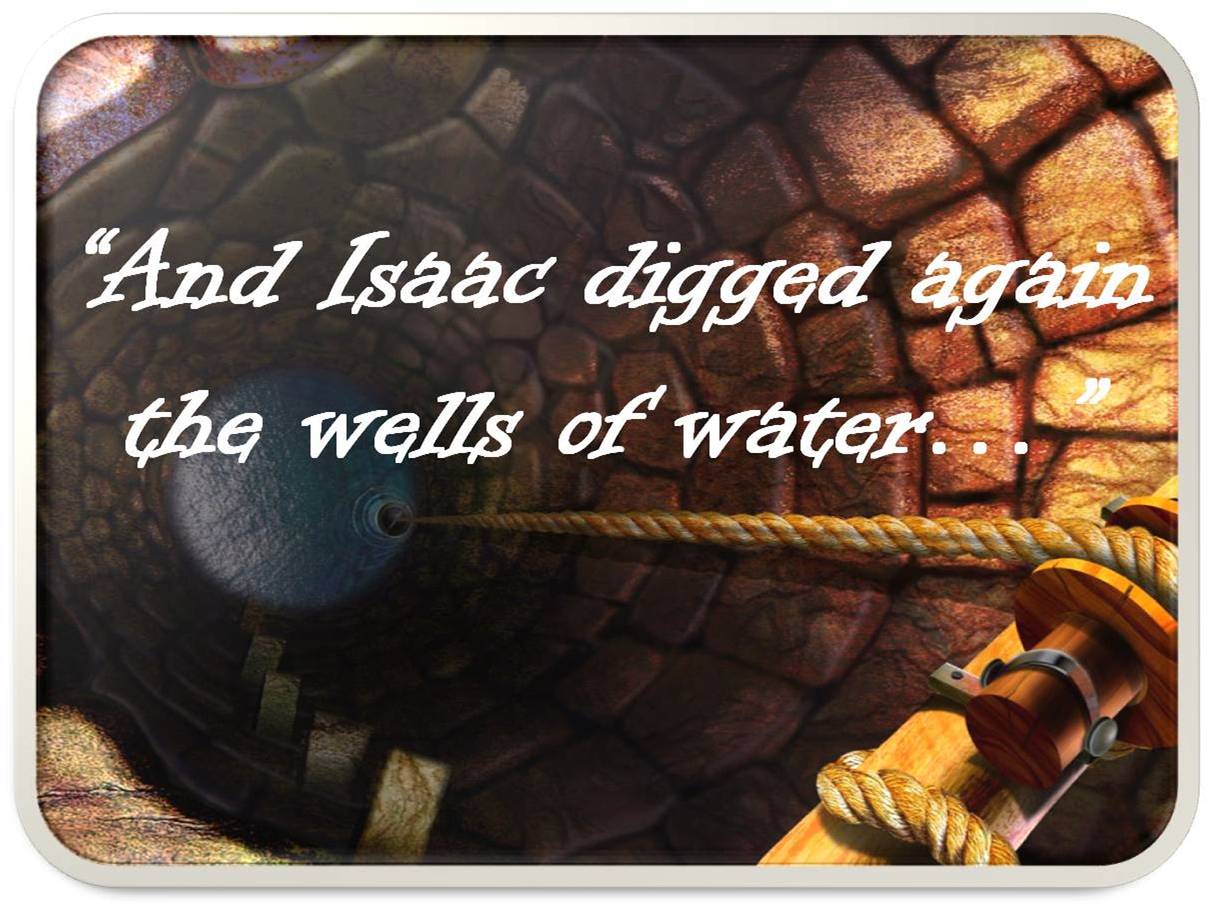
In 2010 I heard Ken Ham give the commencement address at Tennessee Temple University. His message from Genesis 26 was about the need to dig wells. Go read the passage…
…go ahead, I will wait.
It is an amazing story. You see, the Philistines of our generation have stopped the wells using public education, secular colleges, the media, Hollywood, false preachers, teachers, and pretenders. They have filled the wells with lies. In the process they have attempted to eradicate God’s Word and stop the flow of life giving water. That day Dr. Ham charged the audience to go out into the world and, like Isaac, re-dig the wells that have been stopped.
(Let me encourage you to read my blog post about it here and his mention of it here.)
Now that the public debate is over, what are we to do? What comes next for Christians? Simply put, we need to re-dig. We need to take back ground that was once lost. We need to push back and speak up, because the Christian life is not pointless. It has meaning and purpose. We have a mission to accomplish, a gospel to preach, and the truth to proclaim. One bit of dirt that is used to fill the wells is the teaching of evolution as fact. Thousands of children and young adults are indoctrinated with the lie of evolution in our public schools and secular universities. The agenda is to weaken faith in God and promote humanistic religion. (Read more about that here, or watch what top evolutionary scientists have to say here.) Christians can and should re-dig in this area.
Not only are we to re-dig stopped up wells, but we are to be about building new ones. Jesus said, “whosoever drinketh of the water that I shall give him shall never thirst; but the water that I shall give him shall be in him a well of water springing up into everlasting life,” John 4:14.
The building of new wells can only be accomplished through the gospel – a truth that Ken Ham certainly understood the night of the debate.
Let’s talk about LOVE…
By the middle of February some people are sick of hearing about romance, Valentine’s Day, gifts, cards, and even love. But can love be over-emphasized? As believers in Christ we are to walk in love (Ephesians 5:2), be rooted and grounded in love (Ephesians 3:17), follow after love (I Timothy 6:11), and put on love (Colossians 3:12-14). Can we talk about it too much? Love is a consistent theme throughout the entire Word of God. The greatest command in all of scripture is to love the Lord our God with all of our heart, soul, and mind. The second command is to love our neighbor as ourselves. Jesus said that, “On these two commandments hang all the law and the prophets,” Matthew 22:40. To put it differently, the entire Bible can be summed up with love.
Love is a wonderful topic for study and February is a great time to gather your family up for such a study. A good place to start is with the writings of the Apostle John. Love envelops his epistles. In 1 John alone we see 46 different forms of the word love. Let me share just a few truths about love that adorn these inspired epistles.
-
God is love. (1 John 4:8)
-
We cannot truly love until we know God. (1John 4:7-8a)
-
We love Him because He first loved us. (1 John 4:19)
-
There is no fear in love. (1 John 4:18)
-
There are certain things that God does not want us to love. (1 John 2:15)
-
Love and truth go hand in hand. (1 John 3:18, 2 John 1:1-3, 3 John 1:1)
-
If you love God you will love God’s children. (1 John 3:11, 3:14, 3:23, 4:7, 4:21, 5:2)
-
God demonstrates His love through His actions. (1 John 4:9-10)
-
We demonstrate our love for God through our actions. (1 John 2:5, 1 John 5:3, 2 John 1:6)
-
We demonstrate our love for others through our actions. (1 John 3:16-17)
If you would like an additional resource for personal use or to use with your family consider getting a copy of Love: A verse by verse study through the Epistles of John. It is a study that dives into the deep truths of God and His great love.
The Comparison Game
A couple of years ago I was at the place where the year was quickly dwindling down and it had been rather hectic. As I realized that there were only a few months left of school, deep down there was a part of me that began to panic. I felt like I had failed at giving my children the best education possible. In fact, if report cards were to come out on me – the children’s teacher – I was to the point where I would have been satisfied with a C-. I was discouraged, and yet no one knew it.
A homeschool monthly mom’s meeting was scheduled on the topic of “Homeschooling through the High School Years” and I knew this was just the encouragement I needed. So I put on a smile and headed out the door. But what was intended to lift my spirits, turned into guilt and great discouragement. As I listened to various moms share their experiences, I began to compare my life to them and a few hours later ended up driving home in tears.
My discouragement lasted through the next day, until I finally picked up the precious Word of God.
“In all thy ways acknowledge him, and he shall direct thy paths,” Proverbs 3:6.
“Let thine eyes look right on, and let thine eyelids look straight before thee. Ponder the path of thy feet, and let all thy ways be established,” Proverbs 4:25-26.
It was clear. My eyes were not fixed upon God. I was looking around to the left and right, comparing myself and my family to everyone else. And it is just that – the comparison game – that will leave us discouraged every time.
This is not the only thing that can contribute to this type of discouragement for moms. Books, magazines, and social media can all add weight to the problem. Ideas of having the “perfect” marriage or a busy mom’s guide to “getting it all done” can raise our levels of expectations to an unhealthy level. Pictures on Pinterest of beautifully-decorated, insanely-organized, and superbly-spotless homes can also add to the comparison game.
Here’s the truth: Every family will look different. No marriage is perfect. We cannot and should not even try to do everything. And, having a lived-in home when love and laughter flows, is much better than the “picture-perfect” home where all are stressed over spills and messes.
Don’t get me wrong. We are built for relationships and God will often use people to encourage and exhort us to be better wives and mothers. We should examine and learn from others, and we should follow after those who are living godly lives. The Apostle Paul said, “Be ye followers of me, even as I also am of Christ,” I Corinthians 11:1. But there is a difference between following others by letting their example be an encouragement to us, and comparing our lives to theirs. The Bible warns us to not compare ourselves with others in spiritual matters. “For we dare not make ourselves of the number, or compare ourselves with some that commend themselves: but they measuring themselves by themselves, and comparing themselves among themselves, are not wise,” 2 Corinthians 10:12. The principle applies here as well. It is easy to want to compare ourselves to others, but it is not others that should set our standards. God’s plan for our life is the standard all must seek. God created each of us in a unique way. He created our family unique. Unless we embrace our differences and seek out God’s will for our family, we will constantly struggle in this area.
There is a fine balance between striving for excellence as wives and mothers, and killing ourselves by trying to live up to some unattainable form of perfection that we “think” we see in others. Let’s not forget that often we are only seeing highlights of people’s lives, moments of triumphs, and glimpses of won victories. Often the failures, struggles, and disappointments are not on display. This comparison game trap was a good reminder for me as well. When talking to a new believer, a first time homeschooler, or a newlywed I need to remember that each child of God is on a journey in life to walk in the ways of the Lord. We are all striving to live our life and raise our family in a way that is pleasing to Him. Some are simply further down the road than others. Some have been traveling longer. Some travel at a faster pace. And some take a different path altogether. My life will not look like yours. Your life will not look like mine. But let each of us look like Christ. If we are going to compare our lives with anyone, let it be His! “He that saith he abideth in him ought himself also so to walk, even as he walked,” 1 John 2:6.
Be content to travel down the path that God has laid before you. Acknowledge Him, take your eyes off self, focus upon the One who establishes all your ways, and let the peace of God which passes all understanding keep your heart and mind focused upon Him.
The American Bible Challenge
“If you have a show that encourages people to open this book (the Bible) and delve into it, and learn not only what God says about Himself but what He says about you – that’s a win, win!” Jeff Foxworthy
The American Bible Challenge, hosted by Jeff Foxworthy, premiered on the GAME SHOW NETWORK last night. Did you see it? I believe that the Bible is the holy, inspired, infallible, all sufficient, precious Word of God and should not be treated any less. So I was somewhat apprehensive when I first heard about this new game show. Would it turn out to be offensive? Or, make light of God’s Word? Or, could it possibly be a show that glorifies God and His Word? Would people be encouraged to study the Bible and learn more of it by watching this? I must say that after watching The Making of the American Bible Challenge (you can watch it here) and catching the last few minutes of last night’s show, I believe that The American Bible Challenge does appear to be a “win-win”.
What impressed me most with The Making of the American Bible Challenge was the heart behind the producers to magnify God’s Word in a very respectful way. Also, I learned a lot about Jeff Foxworthy that I didn’t know. Truthfully, all I knew about him was his redneck jokes. However, I learned that he is indeed a believer. He grew up with a mother who is a mighty prayer warrior. He teaches the Bible to a group of homeless men each Tuesday, and has an accountability group that he has met with each Thursday for the past 15 years. In reference to the Bible he said, “It exactly applies to me. It applies to my life right now.”
Jeff closed the show with, “If you don’t know your Bible – You don’t have a prayer!” I couldn’t agree more and will add that if you don’t know the God of the Bible and His Son, you certainly don’t have a prayer!
My prayer is that this show will be successful and that many people will be pointed to God and His Word through it. If you haven’t seen it yet, check out the below sites.
Website: http://gsntv.com/shows/the-american-bible-challenge/
Trailer: http://gsntv.com/shows/the-american-bible-challenge/videos/
Facebook: https://www.facebook.com/theamericanbiblechallenge
By the way, I have my own Bible Challenge for you.
What book in the Bible tells us that hell has enlarged herself?
*****The first person to comment and correctly answer this question will be sent a Zondervan Quest Bible and The American Bible Challenge T-Shirt.
Happy searching!
Disclosure: I received the give-a-way product mentioned above for free in the hope that I would mention this on my blog.
Water, Wind, and Waves
The beach was rather refreshing. One day a small girl, with the help of her mother, diligently worked on a sand castle. A young couple entered the water together, laughing and enjoying life. A group of boys played volleyball. A few surfers ventured out to catch a wave or two. Several people relished in the warmth of the sun and simply relaxed. The waters announced its grandeur with each consistent roar. You could almost hear the waves, in a near boastful tone calling out with authority, “You are here to see me. I am the reason you have come.”
What is it about the beach that draws people? Is it the cool breeze from the ocean? Is it the sound of the waves rushing against the shore? Perhaps it is simply the ability to sit and rest without great expectation. I sat and reflected this past week with my feet buried deep into the warmth of the sand. How can man look at the vastness of the ocean and not be drawn to our Creator? The Psalms declare, “The voice of the Lord is upon the waters: The Lord of glory thundereth: the Lord is upon many waters,” Psalm 29:3. If we will open our eyes, we can see the Lord’s hand in all of creation. If we will listen, we can hear the Lord speaking through his creation. If we will allow it, we can be drawn closer to the Lord through His creation.
One particular morning the waves were exceptionally boisterous and the undercurrent rather strong. The children and I enjoyed the waves but stayed close to the shore. Dana kept a watchful eye at the edge of the water. He never moved. After a few minutes we would look toward the beach and notice that we have drifted far in one direction. It took an intentional effort on our part to stay in the area in front of my husband. Every now and then Aaron, watching out for his little sister and brother, would remind them to come closer. If not careful, the waves would easily carry us miles away.
As we were moved about by the strength of the water, wind, and waves I could not help but think about the passage in Ephesians about being, “tossed to and fro, and carried about with every wind of doctrine.” Oh, how easy it is to be tossed about in our spiritual life. It takes a strong anchor of faith to not waver these days. (“For he that wavereth is like a wave of the sea driven with the wind and tossed,” James 1:6.) Not only do we need a strong faith in God and His Word, but we need desperately need the church. The church? You might ask; What does that have to do with this passage in Ephesians about being “tossed to and fro”? Let’s look at it in context.
And he gave some, apostles; and some, prophets; and some, evangelists; and some, pastors and teachers; For the perfecting of the saints, for the work of the ministry, for the edifying of the body of Christ: Till we all come in the unity of the faith, and of the knowledge of the Son of God, unto a perfect man, unto the measure of the stature of the fulness of Christ: That we henceforth be no more children, tossed to and fro, and carried about with every wind of doctrine, by the sleight of men, and cunning craftiness, whereby they lie in wait to deceive; (Eph 4:11-14)
Notice the gifts Christ gave for the provision and edification of His church. Are you blessed to be a part of a local, Bible teaching, New Testament church? It is easy to see the necessity of the church in correlation to the perfecting of the saints, work of the ministry, and edifying of the body of Christ –without it we can easily be “tossed to and fro and carried about with every wind of doctrine.” Just as the children and I needed to look to the spot my husband stood to keep us from drifting too far, so do we need to keep our eyes fixed upon Jesus, the author and finisher of our faith. And just as we depended upon each other while we were in the waters for safety, God’s children in like manner needs the local church. “Let us hold fast the profession of our faith without wavering; (for he is faithful that promised;) And let us consider one another to provoke unto love and to good works: Not forsaking the assembling of ourselves together, as the manner of some is; but exhorting one another: and so much the more, as ye see the day approaching,” Hebrews 10:23-25.
Exercises in Generalizations
There is something remarkably precious about the love and fellowship shared between brothers and sisters in Christ. Last night, our family was standing in the parking lot of our church talking with one of the men on our executive leadership team and his sweet wife. We were doing some work around the church building, visiting, laughing, and enjoying each other’s company. Then, as usual, we started talking about the church and doctrine. In our church, doctrine is often discussed. We love it, teach it, and hold to it. My husband often reminds the congregation that we not only need to know what we believe, but why we believe it. Yet, when you talk to a lot of Christian people today, doctrine seems to be irrelevant. Really, is it that important? I will submit that of course it is; that is unless we want to be “children, tossed to and fro, and carried about with every wind of doctrine,” Eph 4:14. And yet, it seems like that is just the case. People are carried about with every (and I mean every) wind of doctrine.
“I’ll believe this, this week.”
“That sounds good for next week.”
“Teach me something new under the sun, I’ll believe it too!”
My husband explains it like this. Many pastors’ sermons are simply exercises in generalizations. They do not know the Bible; therefore, they do not teach it to their flock. Due to this, people are biblically illiterate. Consequently, they will believe anything (or in some cases nothing at all). So as a result, people will often shy away from sound doctrine, because it has gotten to the point of sounding foreign to the “average” church-goer. Could it be that we have reached the time where “they will not endure sound doctrine,” 2 Timothy 4:3?
I am so thankful for all the pastors who hold fast to the faithful words that they, “may be able by sound doctrine both to exhort and to convince the gainsayers,” Titus 1:9. And for the men of God that “speak thou the things which become sound doctrine,” Titus 2:1. Keep it up! The Lord is pleased. There are many out there who are doing just this. I am, of course, partial to one in particular. I really love my husband’s preaching. I have learned so much by the expository, verse by verse, teaching of God’s Word. And, I’m thankful for the churches that have ears to hear and that truly want to follow God’s precious Word. Our church is an example of one. I love our church. Each and every one of them! Our people have a heart’s desire to know the Word of God and obey it. We not only have unity, but our unity is built on the truth (sound doctrine) of God’s Word.
Biblical Discernment in a World of False Teaching – Part Five
There is a lot of talk about the cultural relevant church, but just what does this mean? I have heard it said that we must be culturally relevant if we want to reach the world and I have heard others oppose the notion. I believe our biggest problem is taking terminology that is outside the Scriptures (cultural relevant) to describe mandates derived from the Scriptures. People get confused when this happens and the message becomes unclear. So, let’s look at the definitions of cultural and relevant.
Cultural – relating to a culture or civilization
Relevant – having social significance, some bearing on or importance for real-world issues, present-day events, or the current state of society
One writer said, “It’s about being relevant and engaging culture. The church must be relevant and understand that we live in an ever-changing and ever evolving culture, if we want to reach people for Christ. The methods must change, but the message ‘the Word’ never changes.”
I can agree with most of this statement. We most certainly live in an ever-changing culture and certain methods should change. I do not know of any circuit riding preacher who is still traveling around on horseback preaching the gospel. I like our current mode of transportation, thank you! I’m also rather thankful for the internet. Our church can broadcast the gospel all over the world with a few clicks of a button. To disregard our modern technology simply relates to loss opportunity in reaching out to the lost with the gospel. So what is the problem and where is all the confusion?
It is interesting to note that those that promote cultural relevance always states that “the Word never changes.” I have, however, found this to be untrue in some cases. In an effort to have social significance some will cast off the Word for a more palatable substitute. Sitting around talking about real life issues is not the same as teaching God’s Word and preaching the gospel of Christ.
Another problem arises when we confuse the function of the church with personal evangelism. My husband often reminds us that the church is a people, not a place. The Greek word for church is ekklesia which means a called assembly. The local church is a called out assembly of baptized believers who have coveted together to carry out the great commission. Therefore, church is for the saved. Let me say that again because I believe very few truly understand this. Church is for the saved not the unregenerate world. When we come together in the assembly, it is to worship God. The lost cannot or will not do this. When we come together in the assembly, it is to learn from God’s Word. The lost do not even understand God’s Word. “The natural man receiveth not the things of the Spirit of God: for they are foolishness unto him: neither can he know them, because they are spiritually discerned.” 1 Corinthians 2:14. When we come together in the assembly, it is to love, exhort, and edify one another. Without God’s love the lost cannot grasp the meaning of loving the brethren and all it encompasses. And when we come together in the assembly it is to equip us for the work of the ministry. “For the perfecting of the saints, for the work of the ministry, for the edifying of the body of Christ,” Ephesians 4:12.
This is, however, not to say that the lost are unwelcome within the assembly. We should make them feel welcome, but the function of the church is not to bring into the assembly as many lost people as we can find in hopes that they might get saved at the church. If they come in, the purpose should be that they will watch true believers worship the True God, hear the preaching and teaching of the Word, and witness the love for the brethren within the church. Should God draw them and stir their hearts so they get saved within the assembly, praise God. But the churches function is not to be seeker sensitive. We should not adapt the preaching and teaching to their pleasure. (In fact, Jesus preached and taught counter-culturally and was crucified for it. Why would we expect any less from the world?) And while we desire to make them feel comfortable, the truth is that an unsaved man or woman will not be comfortable when the truth of God’s Word is proclaimed. What we need to be sensitive to is God’s desires and His will for His church. The church comes together to worship, learn from God’s Word, and love one another. It is then that we go out into the world to reach and evangelize our neighbors and loved ones. This is done on a personal level, one by one. Once the lost are saved, we should seek to bring them into the assembly so they too can worship God, learn from His Word, and love the brethren.
If the churches focus is always on being culturally relevant, the true “ministry of reconciliation” that we are given will quickly grow irrelevant. When the center of attention is on the culture, often the purity of the church and the sanctification of believers are de-emphasized. The problem with being cultural relevant is that too much attention is being given to making sinners feel comfortable, being seeker sensitive, and fitting in with the world. Therefore, too little attention is given to repentance from sin, being sensitive to God’s Word, and confronting the culture.
The church is to be different from the world. We are not to look like, act like, or live like the world. We are to be holy, set apart, and peculiar. I find that a focus on cultural relevance often ignores these truths. Eric Davis states it plainly, “Christ was so relevant, not because he was methodologically trained in missional living, but because he was so holy. The most effective missional living is not crafting the most culturally relevant outreach technique, but in transformed people who are actually salt and light. Spiritual maturity through sanctification best equips God’s people for evangelism over cultural methodology.” [i]
“And be not conformed to this world: but be ye transformed by the renewing of your mind, that ye may prove what is that good, and acceptable, and perfect, will of God.” Romans 12:2
Biblical Discernment in a World of False Teaching – Part Three
American Heritage Dictionary gives the definition of ecumenical as “of worldwide scope; universal; of or relating to the worldwide Christian church; concerned with establishing or promoting unity among churches or religions.” This heresy is very dangerous. This movement rest on the premise that doctrine is not important and it doesn’t matter what you believe as long as you have a personal relationship with Christ. It is true that a personal relationship with Christ is the most important thing, but it is sound doctrine that leads us to Him. The thought is that “we’re all going to the same place; we are just taking different roads.” Those that promulgate this idea are usually very sincere, but unfortunately being sincere does not automatically make a teaching true.
There are many evangelistic teachers that take this ecumenical stand. And it is done under the banner of unity. Charisma magazine did an article on one particular well known female teacher in June 2003 in which they praise her saying, “she doesn’t get caught up in divisive doctrinal issues. In fact, she purposely steers clear of topics that could widen existing rifts between different streams in the body of Christ.” Did you catch that? She purposely steers clear of topics. Let me translate that phase. She refuses to teach certain parts of the Bible because if she did she might offend certain groups. To hold this view means that you will not teach the entire Bible as the Inspired Word of God because if you did you would be “widening existing rifts” among believers.
Ecumenical teaching is dangerous because it weakens the faith. Having a standard and raising up walls of separation is a way of protecting the local church from error and heretical, false teachings. And it is nothing new. Look at what Charles Spurgeon said many years ago,
“To remain divided is sinful! Did not our Lord pray, that they may be one, even as we are one”? (John 17:22). A chorus of ecumenical voices keep harping the unity tune. What they are saying is, “Christians of all doctrinal shades and beliefs must come together in one visible organization, regardless… Unite, unite!” Such teaching is false, reckless and dangerous. Truth alone must determine our alignments. Truth comes before unity. Unity without truth is hazardous. Our Lord’s prayer in John 17 must be read in its full context. Look at verse 17: “Sanctify them through thy truth; thy word is truth.” Only those sanctified through the Word can be one in Christ. To teach otherwise is to betray the Gospel. Charles H. Spurgeon, The Essence of Separation, quoted in The Berean Call, July 1992 p. 4.
Unity is very important but not at the cost of truth. There is an even wider and more dangerous ecumenical movement that states we should bring together in unity not only all Evangelicals but also all world-wide religions – Christians, Muslims, Buddhists, Hindus, New Agers, etc. One example of this would be the 2007 document published in the NY Times titled, A Christian Response to A Common Word Between Us and You. The base is that Christians and Muslims come together in friendship and unity. American’s Pastor Rick Warren has received mass criticism for signing this document. And rightly so; you can see it here.
You can call it friendship, partnership, alliance, or common ground if you like, but the Scriptures call it yoked, fellowship, communion, concord, part, and agreement. “Be ye not unequally yoked together with unbelievers: for what fellowship hath righteousness with unrighteousness? and what communion hath light with darkness? And what concord hath Christ with Belial? or what part hath he that believeth with an infidel? And what agreement hath the temple of God with idols? for ye are the temple of the living God; as God hath said, I will dwell in them, and walk in them; and I will be their God, and they shall be my people. Wherefore come out from among them, and be ye separate, saith the Lord, and touch not the unclean thing; and I will receive you,” 2 Corinthians 6:14-17.
We need to be careful when it comes to the promotion of ecumenical beliefs. It often masquerades as unity and love and it is hidden in our churches and dwells among many leaders. But the ecumenical movement treacherously opposes the truth.
Biblical Discernment in a World of False Teaching – Part One
“Discernment is not simply a matter of telling the difference between what is right and wrong; rather it is the difference between right and almost right.” Charles Spurgeon
In this world there is certainly a lot of “almost right” out there. But as I have said before, the most dangerous lie is the one closest to the truth. Therefore, for the Christian, biblical discernment is imperative. I’ve been thinking about all of the false teaching out there today. Certainly, false teaching is nothing new. Practically every one of the New Testament epistles deals with recognizing and exposing false teachers.
Jesus dealt with it. “Beware of false prophets, which come to you in sheep’s clothing, but inwardly they are ravening wolves,” Matthew 7:15. The apostles dealt with it. “As we said before, so say I now again, If any man preach any other gospel unto you than that ye have received, let him be accursed,” Galatians 1:9.
The first century church dealt with it. “For I know this, that after my departing shall grievous wolves enter in among you, not sparing the flock. Also of your own selves shall men arise, speaking perverse things, to draw away disciples after them,” Act 20:29-30.
And if we love the truth, we will deal with it and do our best to expose it. “I know thy works, and thy labour, and thy patience, and how thou canst not bear them which are evil: and thou hast tried them which say they are apostles, and are not, and hast found them liars,” Revelation 2:2.
(See also Matthew 24:4-5, Matthew 24:23-24, Luke 21:8, Romans 16:18, 2 Corinthians 11:13, Ephesians 4:14, Philippians 3:18-19, I Timothy 4:1, 2 Timothy 2:17-18, Titus 1:10-11, 2 Peter 2:1, 2 John 1:7, 10, Jude 1:4)
The Apostle John tells us, “Beloved, believe not every spirit, but try the spirits whether they are of God: because many false prophets are gone out into the world,” 1 John 4:1.
Not every spirit is of God. The Bible speaks of evil, unclean, dumb, foul, and deaf spirits. It tells of the spirit of infirmity, spirit of divination, spirit of bondage, spirit of the world, spirit that “worketh in the children of disobedience,” spirit of antichrist, and the spirit of error. Not every teaching is correct. A false spirit produces false teachers that fabricate false doctrine. “…many false prophets are gone out into the world.” This is why biblical discernment is so important. I believe there are truly many Christian men and women who want to teach the truth to others. They are sincere. Perhaps their motives are pure. But, they have not filtered all of their teaching through God’s Word. To try the spirits means to test or prove them. “Prove all things; hold fast that which is good,” 1 Thessalonians 5:21.
There are two ways to test a spirit. The first is by the Word of God. The believers in Berea were nobler than the ones in Thessalonica because they “searched the scriptures daily, whether those things were so,” Act 17:11. If a doctrine does not line up with Scripture it is wrong. The Spirit of God will never contradict the Word of God. It will never supersede the written word. Just as Christ came to do the will of the Father and glorify Him, the Spirit will point people to Christ and glorify Him. John 1:1 tells us that Jesus is the Word of God. Revelations 19:13 tells us that “The Word of God” is His very name. We also know that “all scripture is given by inspiration of God,” 2 Timothy 3:16. To say that the Spirit would lead us or teach us something contrary to Jesus Christ (The Word) is untrue.
The second way to test the spirits is by their fruits. Jesus said in Matthew 7:20 “by their fruits ye shall know them.” You cannot separate a man’s personal life from his ministry. Does his life line up with what he is teaching? Be careful to accept every teaching as truth. You need to make sure that what is taught is first biblical and second that those teaching have a life that demonstrates good works. “Who is a wise man and endued with knowledge among you? let him shew out of a good conversation his works with meekness of wisdom,” James 3:13.
If the Spirit of God dwells in us, by knowing the Word of God and examining fruits we can test the spirits to see if they are of God. “God hath revealed them unto us by his Spirit: for the Spirit searcheth all things, yea, the deep things of God.” 1 Corinthians 2:10.
Like I said, I am concerned about all the good sounding, “almost right”, man-centered ideas that are ever constantly being proclaimed about God and His Word. I am not saying that those who teaching such things are “false prophets” but I do believe many are misguided. And if we are not careful, we will let their teaching influence our beliefs. Over the next few days I will be address some of these fallacies that are prevalent today.
- Gospel Message without Repentance
- Ecumenical Movement
- Labels & Doctrines of Men
- Cultural Relevance
- Pragmatism