The Church Hurt Me!

Lately I have come across several online comments regarding the church in general.  Below are a few that I have recently read.

  • “I love Jesus; I just don’t like the church!”
  • “The church hurt me.”
  • “Church people are some of the cruelest people out there.”
  • “I turned my back on God because I was hurt by the church.”

I have been in church my entire life and I understand why people say these things.  I too have experienced mean, vicious, evil spirited people within the church.  I too have been hurt.   But not once did it make me want to cast off the church.  It fact, it has drawn me closer to Christ and His Word and it has given me a deeper love for the true church of God.  You see, we have a mistaken view that those that do such things are a part of the true church.  Most of the time, this is not the case.  They are simply pretenders, charlatans, and wolves in sheep clothing.  They are either unknowingly or in some cases intently seeking to destroy the reputation of the church.  And by the looks of things, they are doing a good job.

But, let us not forget that for every one negative account there are hundreds of positive ones.  For all the groups of non-believers who selfishly try to run the church, there are groups of true believers who have a heart’s desire to come together with their brothers and sisters in Christ to carry out the work of Kingdom.  For every one pastor who is foolish, ignorant, or just plain mean, there are thousands who are true servants of God, working tirelessly day and night, loving, serving, and ministering to people.  For every one hurtful word said, there are thousands of words spoken that have ministered grace unto the hearers.  For every false doctrine proclaimed by false teachers, there are still more who boldly proclaim the unequivocal truth from God’s Word.

Christ loves the church. (The true church, that is.) Christ established the church.  Christ died for the church. It is His Bride.  When we talk about the church in general, we are talking about the Bride of Christ.  We better be careful!  Quit being used by the enemy to destroy the reputation of the church.  Quit looking at self.  I know you’ve probably been hurt, but grow from it, move on, and lift your eyes and take notice of all the good that is in Christ’s true church.  And by all means, if you are in a church where Christ is not preeminent, that is not preaching the truth, not loving the brethren, not doing the work of the Kingdom, not edifying the believers, and does not look like the church should look like then find a true church where you can worship and serve.  True churches are out there.  I know, my husband is the pastor of one.  Sometimes it just takes a while to find one. But remember the words of Christ, “I will build my church; and the gates of hell shall not prevail against it,” Matthew 16:18.

Biblical Discernment in a World of False Teaching – Part Six

Pragmatism

“How is your church doing?”  It is a common question asked among Christians.  I have found that what people usually want to know when asking this is, “How are the churches ABC’s (attendance, buildings, and cash flow)?”  Unfortunately, too often man will use these measures to gauge success.  But is attendance, or numbers, the most important criterion for success?  What about the building?  Does a beautiful multi-purpose church building have anything to do with success?  What about cash flow?  Is wealth really a factor?

Our answers to these questions need to be rooted in the Scriptures and I have yet to find in the Bible success defined by these factors.  For example, in the Pastoral Epistles, Paul does not instruct the young pastors to be concerned with numbers.  While numbers, in the proper perspective, can shed some light into the amount of lives that are being transformed, they do not on their own measure success.  And since the church is a “people and not a place” the building is irrelevant when measuring success.   And being rich is not always a sign of God’s blessing and approval as in Revelation 3:17.  (But, I have found that the purity of a church in doctrine and practice is vitally important to the Lord.)

Yet still, it seems as though this is what the world is looking for in a church – a large, vibrant, relevant church that appeals to the flesh.  Instead of asking whether or not the church preaches and teaches the truth or even where God wants me to worship and serve, the question more often is asked, “What will this church do for me?” or “Is this church big enough, beautiful enough and rich enough to meet all my needs?”   One pastor said, “Mega-churches are cooler, hipper, usually more exciting than other area churches, therefore they are natural gathering points for already-converted people who are looking for ‘something more’ – namely more program options, better worship, more services with fewer demands…”

And because this is such a common attitude we can quickly become pragmatic when we use man’s standards to define success instead of God’s Word.

What Is Pragmatism?

Prag`mat`ic – more concerned with practical results than with theories and principles

Pragmatism is the belief that worth is determined by practical consequences.  In other words, if a technique has a desired effect, it is good.  If it doesn’t work then it must be wrong.  In the pragmatic church the only question that matters is, “What will work to grow and prosper our church?”  John MacArthur often speaks out against the pragmatic movement so prevalent today.  In one sermon he said,

Some church leaders evidently think the four priorities of the early church—the apostles’ teaching, fellowship, the breaking of bread, and prayer (Acts 2:42) make a lame agenda for the church in this day and age. Churches are allowing drama, recreation, entertainment, self-help programs, and similar enterprises to eclipse the importance of traditional Sunday worship and fellowship. In fact, everything seems to be in fashion in the church today except biblical preaching. The new pragmatism sees preaching—particularly expository preaching—as pass‚. Plainly declaring the truth of God’s Word is regarded as offensive and utterly ineffective. We’re now told we can get better results by first amusing people or giving them pop-psychology and thus wooing them into the fold. Once they feel comfortable, they’ll be ready to receive biblical truth in small, diluted doses.

Pastors are turning to books on marketing methods in search of new techniques to help churches grow. Many seminaries have shifted their pastoral training emphasis from Bible curriculum and theology to counseling technique and church-growth theory. All these trends reflect the church’s growing commitment to pragmatism.[i]

So, let’s be committed to God’s Word.  Let’s measure success by His definition.  And let’s cast off pragmatic ideas about church growth and look to the truth found in Scripture.  And truth is certainly not tested by what works and what doesn’t work.

“These things command and teach. Let no man despise thy youth; but be thou an example of the believers, in word, in conversation, in charity, in spirit, in faith, in purity. Till I come, give attendance to reading, to exhortation, to doctrine.”  (1Timothy 4:11-13)

“Preach the word; be instant in season, out of season; reprove, rebuke, exhort with all longsuffering and doctrine. For the time will come when they will not endure sound doctrine; but after their own lusts shall they heap to themselves teachers, having itching ears; And they shall turn away ears from the truth, and shall be turned unto fables. But watch thou in all things, endure afflictions, do the work of an evangelist, make full proof of thy ministry.” (2 Timothy 4:2-5)

Biblical Discernment in a World of False Teaching – Part Five

Cultural Relevance

There is a lot of talk about the cultural relevant church, but just what does this mean?  I have heard it said that we must be culturally relevant if we want to reach the world and I have heard others oppose the notion.  I believe our biggest problem is taking terminology that is outside the Scriptures (cultural relevant) to describe mandates derived from the Scriptures. People get confused when this happens and the message becomes unclear.  So, let’s look at the definitions of cultural and relevant.

Cultural – relating to a culture or civilization

Relevant – having social significance, some bearing on or importance for real-world issues, present-day events, or the current state of society

One writer said, “It’s about being relevant and engaging culture. The church must be relevant and understand that we live in an ever-changing and ever evolving culture, if we want to reach people for Christ. The methods must change, but the message ‘the Word’ never changes.”

I can agree with most of this statement.  We most certainly live in an ever-changing culture and certain methods should change.  I do not know of any circuit riding preacher who is still traveling around on horseback preaching the gospel.  I like our current mode of transportation, thank you!  I’m also rather thankful for the internet.  Our church can broadcast the gospel all over the world with a few clicks of a button. To disregard our modern technology simply relates to loss opportunity in reaching out to the lost with the gospel.  So what is the problem and where is all the confusion?

It is interesting to note that those that promote cultural relevance always states that “the Word never changes.”  I have, however, found this to be untrue in some cases.  In an effort to have social significance some will cast off the Word for a more palatable substitute.  Sitting around talking about real life issues is not the same as teaching God’s Word and preaching the gospel of Christ.

Another problem arises when we confuse the function of the church with personal evangelism.  My husband often reminds us that the church is a people, not a place.  The Greek word for church is ekklesia which means a called assembly. The local church is a called out assembly of baptized believers who have coveted together to carry out the great commission.  Therefore, church is for the saved.  Let me say that again because I believe very few truly understand this.  Church is for the saved not the unregenerate world.  When we come together in the assembly, it is to worship God.  The lost cannot or will not do this.   When we come together in the assembly, it is to learn from God’s Word.  The lost do not even understand God’s Word.  “The natural man receiveth not the things of the Spirit of God: for they are foolishness unto him: neither can he know them, because they are spiritually discerned.” 1 Corinthians 2:14.    When we come together in the assembly, it is to love, exhort, and edify one another.  Without God’s love the lost cannot grasp the meaning of loving the brethren and all it encompasses.  And when we come together in the assembly it is to equip us for the work of the ministry. “For the perfecting of the saints, for the work of the ministry, for the edifying of the body of Christ,” Ephesians 4:12.

This is, however, not to say that the lost are unwelcome within the assembly.  We should make them feel welcome, but the function of the church is not to bring into the assembly as many lost people as we can find in hopes that they might get saved at the church.  If they come in, the purpose should be that they will watch true believers worship the True God, hear the preaching and teaching of the Word, and witness the love for the brethren within the church.  Should God draw them and stir their hearts so they get saved within the assembly, praise God.  But the churches function is not to be seeker sensitive.  We should not adapt the preaching and teaching to their pleasure.  (In fact, Jesus preached and taught counter-culturally and was crucified for it.  Why would we expect any less from the world?)  And while we desire to make them feel comfortable, the truth is that an unsaved man or woman will not be comfortable when the truth of God’s Word is proclaimed.  What we need to be sensitive to is God’s desires and His will for His church.  The church comes together to worship, learn from God’s Word, and love one another.  It is then that we go out into the world to reach and evangelize our neighbors and loved ones.  This is done on a personal level, one by one. Once the lost are saved, we should seek to bring them into the assembly so they too can worship God, learn from His Word, and love the brethren.

If the churches focus is always on being culturally relevant, the true “ministry of reconciliation” that we are given will quickly grow irrelevant.  When the center of attention is on the culture, often the purity of the church and the sanctification of believers are de-emphasized.  The problem with being cultural relevant is that too much attention is being given to making sinners feel comfortable, being seeker sensitive, and fitting in with the world.  Therefore, too little attention is given to repentance from sin, being sensitive to God’s Word, and confronting the culture.

The church is to be different from the world.  We are not to look like, act like, or live like the world.  We are to be holy, set apart, and peculiar.  I find that a focus on cultural relevance often ignores these truths.  Eric Davis states it plainly, “Christ was so relevant, not because he was methodologically trained in missional living, but because he was so holy. The most effective missional living is not crafting the most culturally relevant outreach technique, but in transformed people who are actually salt and light. Spiritual maturity through sanctification best equips God’s people for evangelism over cultural methodology.” [i]

“And be not conformed to this world: but be ye transformed by the renewing of your mind, that ye may prove what is that good, and acceptable, and perfect, will of God.” Romans 12:2

Biblical Discernment in a World of False Teaching – Part Four

Labels and Doctrines of Men

My husband says that if he could only claim one “label” it would be that of a Biblicist.  He believes that God’s Word is pure, complete, and with the direction of the Holy Spirit able to be understood.   I have really tried to approach God’s Word in this way as well.  With that said, there are a lot of man-made labels.  I’m a Calvinist…I’m Arminian…I’m reformed…I am missional….I am transformational…..I follow MacArthur…I follow Spurgeon…I follow _______ (fill in the blank with the latest church growth guru)…..I am of Paul….I of Apollos….I of Cephas, etc.  Do you get the point?  It is not that I disregard the teaching of men or certain labels. (In fact, the first church continued “stedfastly in the apostles’ doctrine.” )  Labels can be an effective identifier.  We proudly identify ourselves as Baptists.  But a label is only effective as long as it does not diminish or detract from the doctrines found in Scripture.

An example of this would be the Calvinist’s label.  I have met some who will claim this label without fully understanding it.  I have even met “Baptist” who proudly wears the sign, never understanding that Luther and Calvin persecuted those that believed in true Baptist doctrine.  So why would they claim this label? There is too much of God’s Word that contradicts the teaching; yet many still cling to this man-made doctrine as if it is the gospel itself.  For example, the doctrine of limited atonement is one of the “5 TULIPS” and is the belief that the death of our Lord Jesus on Calvary’s cross was strictly limited in any and all of its aspects only to the elect and that it had nothing to do with the non-elect people of the world. This is a doctrinal issue that has been debated for years by many theologians.  I will not attempt to argue the point (too much) but I will say that we must be very careful to not hold up man’s theology in higher regards than God’s precious Word.  The problem I see with those that take this view is that they filter all of the Scriptures through this one particular doctrine.   In other words, what would normally be simple to understand verses are perverted and twisted so that they will fit into Calvin’s doctrine.   To do so is not only unnecessary but also leads to error.  Ask yourself this.  What do you do when you come across a passage in Scripture about God like this one, “Who will have all men to be saved, and to come unto the knowledge of the truth,” 1 Timothy 2:4.   I have always said that the Bible is the best commentary on the Bible we have.

It seems simple to me.  Where God said that we are the elect, I believe it.  Where God said that He wills all men to be saved, I believe it as well.  When God says that “he hath chosen us in him before the foundation of the world,” I believe it.  And where God says Christ was sent to be the “propitiation for our sins: and not for ours only, but also for the sins of the whole world” I believe it too.  To do otherwise would be to hold up some Scripture over the others.  So you could say I believe in the doctrine of election and in the doctrine of free will.  I believe that Christ died for the entire world, but I also believe that not everyone will be saved.  The Scriptures speak of both and no one verse is more important than the other.  So the best way of refuting the false view of limited atonement (or any of the other false doctrines of men) is by simply reading, studying, and knowing God’s Word.

There are several passages that refute limited atonement.  I believe if these verses were taken without the preconceived notions of man and with the direction of the Holy Spirit that a person could only come to one conclusion.  Isaiah 53:5-6, Matthew 11:28, John 1:29, John 3:14-15, Romans 5:6, 2 Corinthians 5:19, 1 Timothy 2:5-6, Hebrews 2:9, 2 Peter 2:1, 1 John 4:14, 1 John 2:2, Titus 2:11

Obviously certain teachings of Calvinism are not the only teaching I am against.  There are many other man-made doctrines that lead us down a slippery slope of false ideas.  The point is that man is fallible.  Man’s teaching can lead to error.  We are weak and make mistakes.  But God’s Inspired Word is perfect.  He makes no mistakes.  It is without error.   And, it is profitable for doctrine, for reproof, for correction and for instruction in righteousness.  It is His Word we should cling to.  Now don’t get me wrong, this is not to say that man’s teaching is futile.  The Bible is clear that we are to teach others.  But this teaching should never be taken lightly.  Those that teach God’s Word will be held to a high standard.  James warns, “My brethren, be not many masters, knowing that we shall receive the greater condemnation.” James 3:1.  My husband is the pastor of a precious group of believers.  He takes his role of teaching very seriously.

“But we will give ourselves continually to prayer, and to the ministry of the word,” Act 6:4.

“Feed the flock of God which is among you,” 1 Peter 5:2a.

“A bishop then must be…apt to teach,” 1Timothy 3:2.

“And he gave some…pastors and teachers; for the perfecting of the saints, for the work of the ministry, for the edifying of the body of Christ,” Ephesians 4:11-12.

Likewise, I teach women and write expository Bible studies for women.  But my husband and I would be the first to tell you that you should not take our word for it; study the Scriptures for yourself to see if what we are teaching is true.  May we always be like the believers in Berea that were nobler than the ones in Thessalonica because they “searched the scriptures daily, whether those things were so,” Act 17:11.

Biblical Discernment in a World of False Teaching – Part Two

The Gospel Message without Repentance

Last summer I heard a man preach on 4 separate nights.  Each night the gospel was reduced to “Believe and Receive.”  Not once was the notion of repenting proclaimed.  I was shocked and saddened.  Why would a man of God leave out such an important element to the gospel?

Didn’t the forerunner of Christ have a message of repentance?  “In those days came John the Baptist, preaching in the wilderness of Judaea, And saying, Repent ye: for the kingdom of heaven is at hand,” Matthew 3:1-2.

When Christ began to preach didn’t He preach repentance?  “From that time Jesus began to preach, and to say, Repent: for the kingdom of heaven is at hand,” Matthew 4:17.

Wasn’t the Apostles sent out by Christ with the message of repentance?  “And he called unto him the twelve, and began to send them forth by two and two…And they went out, and preached that men should repent,” Mark 6:7,12.

Does not God command all men to repent?  “And the times of this ignorance God winked at; but now commandeth all men every where to repent,” Act 17:30.

Why then would we leave such an important element out?   Some would say it’s too offensive.  Others would say it’s not a big deal.  And some would state it just doesn’t matter.  But let me ask, do we have a better gospel than Christ?  Do we know more than the Apostles?  Is God’s command to repent not relevant for today?  Perhaps the reason repentance is left out is because it makes no sense to preach repentance unless you preach about the wrath of God.  “For which things’ sake the wrath of God cometh on the children of disobedience:” (Col 3:6) And many simply refuse to preach this.  But sadly, it is equivalent to refusing to warn a blind that he is about to walk off a cliff.  Or, you could compare it to a doctor refusing to tell a dying patient just how serious his condition is.  Some will claim that they do not want to preach in a negative light due to the offense it causes.  But, we must ask ourselves, how much more offended will man be when it is too late.

Repentance is very important.  It fact, without it a person cannot be saved.   To repent is to turn from our sins and to God.  It is more than just being sorry.  Did you know that you can be sorry for your sins without repenting of them?  Look at Paul’s address to the Corinthian church, “Now I rejoice, not that ye were made sorry, but that ye sorrowed to repentance: for ye were made sorry after a godly manner, that ye might receive damage by us in nothing. For godly sorrow worketh repentance to salvation not to be repented of: but the sorrow of the world worketh death,” 2 Corinthians 7:9-10.

The gospel without repentance is a false and dangerous gospel. Because of it there are a lot of professing Christians who have never repented or turned from their sins.  They are false converts because they heard a false gospel.  They still walk in darkness because they have never turned from their sins.  Jesus said, “I tell you…except ye repent, ye shall all likewise perish,” Luke 13:3.  Those who preach a watered-down gospel without repentance will one day answer for leading many astray.

Biblical Discernment in a World of False Teaching – Part One

“Discernment is not simply a matter of telling the difference between what is right and wrong; rather it is the difference between right and almost right.” Charles Spurgeon

In this world there is certainly a lot of “almost right” out there.  But as I have said before, the most dangerous lie is the one closest to the truth.  Therefore, for the Christian, biblical discernment is imperative.  I’ve been thinking about all of the false teaching out there today.  Certainly, false teaching is nothing new.  Practically every one of the New Testament epistles deals with recognizing and exposing false teachers.

Jesus dealt with it.  “Beware of false prophets, which come to you in sheep’s clothing, but inwardly they are ravening wolves,” Matthew 7:15.  The apostles dealt with it.   “As we said before, so say I now again, If any man preach any other gospel unto you than that ye have received, let him be accursed,” Galatians 1:9.
The first century church dealt with it.  “For I know this, that after my departing shall grievous wolves enter in among you, not sparing the flock. Also of your own selves shall men arise, speaking perverse things, to draw away disciples after them,” Act 20:29-30.
And if we love the truth, we will deal with it and do our best to expose it. “I know thy works, and thy labour, and thy patience, and how thou canst not bear them which are evil: and thou hast tried them which say they are apostles, and are not, and hast found them liars,”  Revelation 2:2.

(See also Matthew 24:4-5, Matthew 24:23-24, Luke 21:8, Romans 16:18, 2 Corinthians 11:13, Ephesians 4:14, Philippians 3:18-19, I Timothy 4:1, 2 Timothy 2:17-18, Titus 1:10-11, 2 Peter 2:1, 2 John 1:7, 10, Jude 1:4)

The Apostle John tells us, “Beloved, believe not every spirit, but try the spirits whether they are of God: because many false prophets are gone out into the world,” 1 John 4:1.

Not every spirit is of God. The Bible speaks of evil, unclean, dumb, foul, and deaf spirits.  It tells of the spirit of infirmity, spirit of divination, spirit of bondage, spirit of the world, spirit that “worketh in the children of disobedience,” spirit of antichrist, and the spirit of error.  Not every teaching is correct.  A false spirit produces false teachers that fabricate false doctrine. many false prophets are gone out into the world.”   This is why biblical discernment is so important.  I believe there are truly many Christian men and women who want to teach the truth to others.  They are sincere.  Perhaps their motives are pure.  But, they have not filtered all of their teaching through God’s Word.  To try the spirits means to test or prove them.  “Prove all things; hold fast that which is good,” 1 Thessalonians 5:21. 

 There are two ways to test a spirit.  The first is by the Word of God.  The believers in Berea were nobler than the ones in Thessalonica because they “searched the scriptures daily, whether those things were so,” Act 17:11. If a doctrine does not line up with Scripture it is wrong.  The Spirit of God will never contradict the Word of God.  It will never supersede the written word.  Just as Christ came to do the will of the Father and glorify Him, the Spirit will point people to Christ and glorify Him.  John 1:1 tells us that Jesus is the Word of God.  Revelations 19:13 tells us that “The Word of God” is His very name.  We also know that “all scripture is given by inspiration of God,” 2 Timothy 3:16.  To say that the Spirit would lead us or teach us something contrary to Jesus Christ (The Word) is untrue.

The second way to test the spirits is by their fruits.  Jesus said in Matthew 7:20 “by their fruits ye shall know them.” You cannot separate a man’s personal life from his ministry.  Does his life line up with what he is teaching?  Be careful to accept every teaching as truth.  You need to make sure that what is taught is first biblical and second that those teaching have a life that demonstrates good works.  “Who is a wise man and endued with knowledge among you? let him shew out of a good conversation his works with meekness of wisdom,” James 3:13.

If the Spirit of God dwells in us, by knowing the Word of God and examining fruits we can test the spirits to see if they are of God. “God hath revealed them unto us by his Spirit: for the Spirit searcheth all things, yea, the deep things of God.” 1 Corinthians 2:10.

Like I said, I am concerned about all the good sounding, “almost right”, man-centered ideas that are ever constantly being proclaimed about God and His Word.  I am not saying that those who teaching such things are “false prophets” but I do believe many are misguided.  And if we are not careful, we will let their teaching influence our beliefs.  Over the next few days I will be address some of these fallacies that are prevalent today.

  • Gospel Message without Repentance
  • Ecumenical Movement
  • Labels & Doctrines of Men
  • Cultural Relevance
  • Pragmatism

The Fallacy and Reality of Submission

“We are leaving the church.”  The comment was made to my husband who is also the pastor of our church.  The reason given for this couple leaving was that his preaching and teaching regarding women was chauvinistic.  When my husband asked them if they would like to see in Scripture where his teaching came from the wife’s reply was, “You can show me, but that will not change my mind.”  After showing her and her husband several passages, their response was that these verses were written thousands of years ago and do not apply to modern society.

Unfortunately, our culture confuses and undermines womanhood and submission with damaging preconceived ideas.  From the moment a young lady is thrust into society she becomes indoctrinated with feministic teachings contrary to Scripture.  Screaming equality, their feminist philosophy holds to the view that “Anything a man can do, I can do better!”  Once more subtle, it has now become blatant. Too often we hear narcissistic phrases such as:  “A woman needs a man like a fish needs a bicycle” and “I like to think of ‘men’ as the diminutive of ‘women’”.  Perhaps the worse one of all is, “God is just an abbreviation for goddess.”   These catch phrases and slogans slowly and surely eat away at the foundation of biblical womanhood and seek to destroy society as a whole.

Consider these quotes.

Any intelligent woman who reads the marriage contract, and then goes into it, deserves all the consequences. – Isadora Duncan

Women are the only oppressed group in our society that lives in intimate association with their oppressors. – Evelyn Cunningham

I ask no favors for my sex…. All I ask of our brethren is that they will take their feet from off our necks.-  Sarah Moore Grimké

As the radical feminist movement spreads throughout our country, the marks of distinction are no longer clear.  Once stood the ungodly, man-hating, ferocious feminist on one side and the Bible believing, meek, and quiet woman on the other.  But regrettably over the last couple of generations, as professing Christians continue to embrace the world; these two groups are slowly evolving together into what we see today.   You see, the thought that teaching on submission is chauvinistic and that Paul’s writings are not relevant did not come from the world and those outside the church.  These thoughts were voiced by professing Christians within the church.

These are just a few of the modern fallacies of submission being spouted.  Another misconception is that if a woman submits to her husband she becomes a doormat to be abused and walked all over.  The worldly belief is that submission lowers a woman’s worth and that it makes a woman subordinate to man.  All of these ideals are false.  However, we cannot ignore this philosophy and the agenda that is being pushed upon Christians today.  Because there is no such thing as amoral education, we must address the fact that the majority of children are being educated on the foundation of humanistic and secular teaching.  Even children that are being educated on Christian principles are exposed to secular beliefs about manhood, womanhood, and marriage via music, television, books, and society.  If not correctly taught, these children will grow into adults who continue to pass along their misconceptions.

How do we expose the fallacies?  It begins and ends with truth.  So let’s take a look at the realities of submission.  The first thing to recognize is that submission is for Christians.  We falsely assume that the non-believer should follow the dictates of Scripture.  While perhaps they should follow scripture, in truth they cannot.  “But the natural man receiveth not the things of the Spirit of God: for they are foolishness unto him: neither can he know them…,”1 Corinthians 2:14.  God designed marriage.  We see where He ordained it and the structure of it in Genesis chapter two.  Adam is created and is given a job to do and a law to keep.  God then looks out and for the first time says that something is not good.  “And the LORD God said, It is not good that the man should be alone; I will make him an help meet for him,” Genesis 2:18.  Eve is made from the rib of Adam and brought to him by God.   Here is the institution of marriage.  Then in Ephesians 5 we are given the directives for the Christian marriage.   “Wives, submit yourselves unto your own husbands, as unto the Lord. For the husband is the head of the wife, even as Christ is the head of the church: and he is the saviour of the body. Therefore as the church is subject unto Christ, so let the wives be to their own husbands in every thing. Husbands, love your wives, even as Christ also loved the church, and gave himself for it; That he might sanctify and cleanse it with the washing of water by the word,” Ephesians 5:22-26. Submission is “as unto the Lord”.  An unbelieving wife cannot properly submit to her husband because she has not submitted her life to the Lord, just as an unbelieving husband cannot properly love his wife because he has not submitted to the Lord.

Now that the foundation has been laid that submission is only possible for the saved, let’s look at it through the eyes of a believer.  Submission is a beautiful term that we should hold dear.  It is through submission to Christ and as Lord of our life that we are saved.  James 4:7 declares “Submit yourselves therefore to God.”  As we saw in Ephesians 5, a wife’s submission to her husband is “unto the Lord”.  In the same way, a child’s submission to the parent’s is in the Lord (Ephesians 6:1-3).  Likewise, believers are told to submit to those in biblical authority (Hebrews 13:17) and those in authority over us such as our government (Romans 13:1, 1 Peter 2:13).  In general, we are to submit to and prefer one another in a spirit of humility (Romans 12:10, 1 Peter 5:5, Ephesians 5:21).  Submission is a part of the believer’s life.

In addition, submission in the biblical marriage portrays to the world a picture of Christ and His bride. “Therefore as the church is subject unto Christ, so let the wives be to their own husbands in every thing,” Ephesians 5:24.  Just as the church is subject unto Christ, so is the wife to her own husband.  When the Christian wife is not submissive, she is showing the world a distorted depiction of Christ and the church.

 Submission in no way lowers a woman’s worth and makes her subordinate to man.  Christianity, in fact, raises women to a level of honor.  “Likewise, ye husbands, dwell with them according to knowledge, giving honour unto the wife, as unto the weaker vessel, and as being heirs together of the grace of life; that your prayers be not hindered,”  1Peter 3:7.  The “weaker vessel” implies a more delicate or precious vessel, as in a priceless crystal vase.  She is not common but something rare to be held in high regard.   It is made clear that the husband and wife are “heirs together of the grace of life”.  Man and woman are equal in God’s eyes (Galatians 3:28).  But that does not mean they have the same roles.  Society understands this in every instance until it comes to biblical marriage.  For example, the Governor of your state and his assistant are both created equal as human beings.  However, it would be foolish to assume that because of their equality they should have the same role in government.  As a person, the owner of a corporation and a day laborer are both equal.  But it is easy to see and accept the structure of authority when it comes to the workplace.  Likewise, there is a structure of authority in the home, but the enemy seeks to distort it.

What about the ideal that Paul was a chauvinist?  What about the statement that these verses were written thousands of years ago and not relevant to modern society?  First, as believers we must accept that “all scripture is given by inspiration of God, and is profitable for doctrine, for reproof, for correction, for instruction in righteousness,” 2 Timothy 3:16.  It is an error to pick and choose which verses we want to apply.  If we are going to throw out scripture based on when it was written we would have to disregard the entire Bible.  That would include cherished verses like John 3:16.  So the age of Paul’s writings is an invalid point.  Secondly, Paul’s teaching is not based on cultural customs but on God’s design.  The example Paul gives in I Timothy for women’s role is not a cultural one.  He goes all the way back to creation and the structure of authority in the marriage (I Timothy 2:13-14).  In Ephesians we see the mystery of marriage revealed.  “This is a great mystery: but I speak concerning Christ and the church,” Ephesians 5:32.  Again, it is all by God’s design.

Now that the fallacies have been exposed and the realities declared, where will you stand?  Will you stand on God’s Word and the beauty of His plan for marriage or will you stand on the emotions and opinions of the world?  Here is the amazing reality of absolute truth.  You can accept the truth or reject the truth, but you cannot change the truth.  As a Christian woman, you have an awesome opportunity to illustrate the truths of biblical womanhood and submission.  It is a beautiful thing.  It is God ordained.  And it makes for a great, God-honoring marriage.

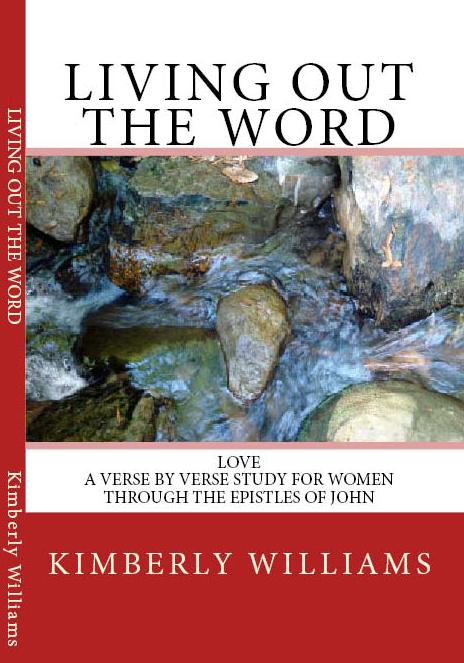
Love: Now Available!

I am so excited to announce that the 3rd book in the Living Out the Word series is now available!  Thank you all for your prayers and support this year as I have worked to complete this project.

If you know of a ladies group that is looking for a verse by verse Bible study please share this information with them.


What does love look like?  Is God’s love like ours, or is ours like His?  Find out what the Apostle of Love has to say in his epistles about God’s amazing love.  Love in not only a general theme within the Epistles of John but also throughout the entire Bible.  The greatest commandment of all is centered on love.  As believers in Christ we are to walk in love, be rooted and grounded in love, follow after love, and put on love.  We are told in 1 John 4:8 that not only does God love, but that “God is love”.  During this verse by verse study, we will drive into the deep truths of God and learn what true love is and how we are to respond.  You can order your copy of Love: A Verse by Verse study for Women through the Epistles of John here!

Blessings to each of you as you strive to Live Out the Word!

State Testing, Standardization, and Godly Standards

With state testing approaching, I’ve had a lot of questions from homeschooling parents about how to prepare and the overall process.  I must say that I am hardly an expert on the subject.  My 15 year old took the Arkansas state test when he was in 3rd grade. After that we moved to a state that did not require state testing.  Now that we have moved back to Arkansas, my children are required to take the standardized tests.  So, we picked up some practice booklets this week.  We got them mostly so the children could practice.  After all, Abigail and Andrew have never “filled in bubbles”.   

When we talk about standardized testing, here is what I want Christian homeschooling parents to know.  If being “standardized” is conformity to a standard, then we need to decide as parents what standard we want our children conformed to.  I wrote an article for Homeschool Enrichment a couple of years ago called Whose Standards Do We Follow.  It is posted below.  I hope that as you are preparing your children for testing this year that it is done with much prayer and with God’s standards in mind.  Blessings!

Whose Standards Do We Follow?

“Mom, who is Oprah Winfrey?” my son asked one day sitting at the kitchen table.  The state we lived in required standardized testing for 3rd through 9th grade.  My son, then 8 years old, was reviewing a practice booklet when he asked the question.  After explaining to him that she was a TV celebrity he asked, “Why do I need to know that?”  With a smile in my heart I replied, “You don’t.”  Later that evening I showed the book to my husband and pointed out several points of concern.  We had come to the conclusion that since the tests were from a secular, humanist, and evolutionary point-of-view, our son would simply be at a disadvantage in taking them.   “Sweetheart, don’t worry about it.”  He said.  “After all, do we really want our children to be standardized?”

It is that very question that we have asked every year since.  As Christian parents do we want our children to be like the rest of the world?  Unfortunately, it is a very easy trap to fall into.  We have a vested interest in our children and want the best for them.  The question is, “What is best?”  Many would agree that if children excel in academics, are well rounded in their social development, are active in sports, can play a musical instrument, are learning a foreign language, score high on the ACT, get a scholarship into a good college, and go on to make a high-paying career for themselves that they are successful.  While the world would unquestionably view this as success, as a believer in Christ, these are not necessarily my standards.  The Apostle John wrote in 1 John 2:15-17 to “Love not the world, neither the things that are in the world. If any man love the world, the love of the Father is not in him. For all that is in the world, the lust of the flesh, and the lust of the eyes, and the pride of life, is not of the Father, but is of the world. And the world passeth away, and the lust thereof: but he that doeth the will of God abideth for ever.”  If we are not careful, our families will indulge in and love the things of this world. This kind of love is to our detriment, for there is a world system that we are not to love or cling to.  The world will pass away therefore the way we live and the standards we set for our children need to be with eternity in mind.  Otherwise, we have sold our children short, “For what is a man advantaged, if he gain the whole world, and lose himself, or be cast away?”(Luke 9:25)

Is it wrong to want our children to excel in academics?  Absolutely not!  But if academic excellence is the goal without the foundation of God and His Word then our priorities are misplaced.  “If ye then be risen with Christ, seek those things which are above, where Christ sitteth on the right hand of God. Set your affection on things above, not on things on the earth.” (Colossians 3:1- 2)  While I want my children to do well in their educational pursuit, I want to measure their success by God’s standards and not the worlds.  Everything that is passed through their minds need to be filtered by the Word of God.  When I taught my 5 year old subtraction my goal was not that he learned the simple mathematic fact of ten minus one equals nine.  My goal was much higher.  Instead, I took him to Luke Chapter 17 and showed him the story of Jesus healing the 10 lepers.  He learned that nine went away and one came back giving thanks to Christ and glory to God.  When we teach with a Biblical mindset, math becomes more than just a lesson.  It becomes an exercise in godliness.

My most important goal as a parent is to teach my children to love the Lord God with all their heart, soul, mind and strength, first and foremost!  Secondly, would be to love their neighbor as their self.   Jesus said that on these two commandments hang all the law and prophets. (Matthew 22:36-40)  I also want to teach them to work hard (Colossians 3:23), not to impress others with their intelligence or for self-centered achievements, but because in working hard we give God glory.  Everything we teach our children can point to God and His glory.  While these goals soar above all others and I fail miserably at times, in truth they are the only ones worth pursuing.  To see how this is practically applied let us look at a few of the core subjects that most children are taught.

Language   –   Whether your child is just learning phonics and how to read or he is diagramming sentences and writing papers, you can easily teach with an eternal perspective.  What is the goal in teaching my child to read?  The most obvious would be that he can read the Bible.  The Creator of the universe and of all that is seen and unseen has given His Word in written form so that we can know Him.  What better motive for teaching my child to read than that?  Why teach my child how to write, speak, and spell properly?  The main reason would be so that he can communicate the glorious gospel to those around him.   Any other achievement would be secondary.  Perhaps, in pursuing the English language your child wins a spelling bee or scores high on a test.  If so, give God the glory.  But do not let those things be your motivation.   The mastering of additional languages can point others to Christ as well.  Perhaps your family is learning Spanish for this reason alone.  Many hearts have been changed and lives given to Christ in foreign lands.  And whatsoever ye do in word or deed, do all in the name of the Lord Jesus, giving thanks to God and the Father by him. (Colossians 3:17)  “Whatsoever ye do” includes phonics, handwriting, spelling, speech, debate, foreign languages, and language composition.

Math  –  What does a Biblical standard verses a worldly standard look like in teaching mathematics?  We have already looked at teaching a small child using Bible stories.  What other incentives do we have for teaching our children math?  One very practical reason is so that our children will be good financial stewards.  My children might not use higher math such as calculus or trigonometry on a daily basis but they will need basic math skills to be able to balance a check book, pay bills, go to the grocery store, or run a business.  All of these things when well done lend to a good testimony for our Lord.   But it could be that our children have a natural gift for mathematics and are able to go on to use their advanced knowledge for the glory of God.  Sir Isaac Newton, mathematician and physicist, would be a wonderful example of this very thing.

Science  –  Biology, ecology, meteorology, geology, and all the other “ologies” are good things to learn.  It is good to know the periodic table and about the laws of the universe but does my child know the Maker of the universe?  Does my child look at a blade of grass or an animal and see God’s handiwork?  Have I taught my child to stand back and look at all of creation in awe and wonder?   Or am I teaching mere facts in order to pass a test and proceed onto the next course of study?  True science will always point us to God.  Louis Pasteur, Father of Microbiology, said it like this, “The more I study nature, the more I stand amazed at the work of the Creator.  Science brings men nearer to God.”

History  –  It would be impossible to teach all there is to know about history.  There is simply too much information.  If we are not careful this subject can become dull names, tedious dates, and boring facts.  However, if we look at history through the sovereignty of God it becomes His Story.    When we realize that nations rise and fall and that the hearts of kings are stirred by God Almighty our perspective on history changes.  What better opportunity to teach our children Biblical morals and values than to have them read about and study godly characters from the past like George Washington?  In studying history we can also teach the mistakes that mankind has made in the past so that our children and future generations are not doomed to repeat them.   We can learn about important moments in history like when Samuel Morse sent the first telegraph message, “What hath God wrought” taken from the Scriptures.  Or perhaps, in our studies of Italy, as we discover the Leaning Tower of Pisa we can use the opportunity to teach our children spiritual truths about building upon a solid foundation.

Bible  –  While most Christian home school families use a Bible curriculum, it is important to remember that even in studying Scripture we can have a worldly mindset.  Every motive should be examined.  If we only teach parables from the Bible without practical application, if we only teach the law of God without the grace and love of God, and if we only teach Scripture memorization without meditation, we come dangerously close to creating little Pharisees.  It is more important to me that my child loves the Word of God than that my child is able to give a dissertation on the missionary journeys of Paul.  While studying the Apostle’s life is important, if my child truly loves the Word of God he will enthusiastically learn as much as he can about the Bible.  If we develop a love for the Word of God in our children and teach them to diligently seek Him we have given our children a precious gift that can never be taken away.

Learning should be an everyday occurrence and it should not be divided up between secular and spiritual.  As a believer everything should be spiritual.  This happens when we incorporate the things of God into our daily studies and activities.  In doing so it changes not only how we teach but why we teach.  We are no longer just concerned with the outcome but now with the process and the application.  Let’s look at an example of teaching my daughter home economics.  Perhaps by the world’s standard she should learn how to cook, sew and take care of a baby.  But is that enough?  In addition to teaching her the fundamentals, by God’s standards I would teach her from Titus 2:4-5 to “be sober, to love their husbands, to love their children, to be discreet, chaste, keepers at home, good, obedient to their own husbands, that the word of God be not blasphemed.”  By the world’s standards it is good for boys to take a shop or woodworking class.  But the application of that would be that my sons learn “to study to be quiet, and to do your own business, and to work with your own hands, as we commanded you; That ye may walk honestly toward them that are without, and that ye may have lack of nothing.”(1Thessalonians 4:11-12)  I should teach them not only how to work with their hands but also how to be the sole-provider for their families (I Timothy 5:8).

So the question is, “By what standards will we choose to live by?”  As Christian parents we must keep in mind that we will be accountable for the education of our children not based on the world but on God and His Word.  In that knowledge there is great responsibility but also great peace.  Responsibility in that we will answer to God alone for how we teach and train our children.  Peace in that we are not bound by the world’s standards for our children.  Remember that academic excellence is a commendable goal but it must be properly laid with the correct foundation.   “For other foundation can no man lay than that is laid, which is Jesus Christ. Now if any man build upon this foundation gold, silver, precious stones, wood, hay, stubble; Every man’s work shall be made manifest: for the day shall declare it, because it shall be revealed by fire; and the fire shall try every man’s work of what sort it is. If any man’s work abide which he hath built thereupon, he shall receive a reward.” (1Co 3:11-14)  The builder (the Christian parent) needs to seek out the Architect himself (God) and use His own blueprints (the Scriptures).  The sure foundation is Jesus Christ and the gold, silver, and precious stones are those things that are of eternal value.  In the end nothing else will matter.  When the fiery trials of life come and when all our works are manifested, we want to know that what we have built into our children will last.  It is those things that we must pursue and by those standards that we must live by.

 Whose Standards Do We Follow by Kimberly Williams, Originally published in Homeschool Enrichment Magazine, Issue #44 March/April 2010 

 

Happy are the Holy

I am sitting here this morning in sweet reflection.  The closing paragraph, last sentence, and final words to my 4th book were written last week.  It is off to the editor and in the hands of the man writing the forward.  The thought of it all brings great happiness.

The Epistles of John have been an incredible study for me personally.  The theme of the books is love.  It covers God’s love to us and our love to others.  But what I did not expect was the amount of love shown by the Apostle to his readers.  What makes his love so revealing is its under-girding of absolute truth.  John writes these letters so that believers might “know that they know” with confidence and assurance that they are in the faith.

Living Out the Word: Love has been perhaps the deepest and most heart revealing ladies Bible study that I have written.  John’s epistles gives a person a series of tests they can take to see if their faith is real.  Have you ever questioned your salvation?  Did you know that it is okay to do so?  In fact, we are commanded in Scripture to do just this.  “Examine yourselves, whether ye be in the faith; prove your own selves,” 2 Corinthians 13:5a.

One of the tests that Johns gives is purity.  I John 3:3 says, “And every man that hath this hope in him purifieth himself, even as he is pure.”  The “hope” this verse is referring to is the hope of Christ’s return (I John 3:2).  We often use “hope” as a synonymic word for “wish”. But do not mistake it here in this verse.  It does not mean wish, want, or desire.  The word conveys a stronger meaning.  The Greek word is elpis and it means having confidence in, earnest expectation, or anticipation.  Hope makes a difference in the life of those who believe.  The person who has the hope (confidence) of one day seeing Christ will purify himself.   Notice also that there are no exceptions to the principle here.   The verse says that every man that hath this hope in him purifieth himself.”  A few weeks ago my husband started an expository study through 1st John.  Yesterday’s afternoon study was on this verse.

As it turned out, my husband is also preaching verse by verse through the book of Matthew during our morning worship service.  Yesterday’s sermon was on Matthew 5:8 taken from Jesus’ Sermon on the Mount.  “Blessed are the pure in heart: for they shall see God.”  To be blessed is to be happy.  To be pure in heart is to be holy.  I was amazed at how the two sermons tied so perfectly together.  Happy are those that are pure in heart (holy) and only those that have the confidence that Christ will return will purify themselves.   So, just what is purity?  My husband explained three types of purity for the believer.  There is positional purity, practical purity, and perfect purity.

Positional Purity is how the believer stands before God. “For ye are dead, and your life is hid with Christ in God,” Colossians 3:3. When God looks at us He sees the precious blood of His Son.  “But if we walk in the light, as he is in the light, we have fellowship one with another, and the blood of Jesus Christ his Son cleanseth us from all sin,” 1 John 1:7.  The believer is positionally pure.

Practical Purity is how we live out our faith.  “Every man that hath this hope in him purifieth himself.” 

  •  “Having therefore these promises, dearly beloved, let us cleanse ourselves from all filthiness of the flesh and spirit, perfecting holiness in the fear of God,” 2 Corinthians 7:1.
  •  “As obedient children, not fashioning yourselves according to the former lusts in your ignorance: But as he which hath called you is holy, so be ye holy in all manner of conversation; Because it is written, Be ye holy; for I am holy,” 1 Peter 1:14-16.
  •  “I beseech you therefore, brethren, by the mercies of God, that ye present your bodies a living sacrifice, holy, acceptable unto God, which is your reasonable service,” Romans 12:1.

Perfect Purity is that day that all believers long for.  “Beloved, now are we the sons of God, and it doth not yet appear what we shall be: but we know that, when he shall appear, we shall be like him; for we shall see him as he is,” 1 John 3:2.  It has not happened yet, but we know that one day we will be like Christ.   Spiritually we are pure but we still live in this sinful flesh.  However, our bodies will one day be glorified (Romans 8:30) and we will be perfectly pure.  What a day that will be!

It is the realization that we are positionally pure and the expectation of one day being perfectly pure that gives us the desire to live out our lives in practical purity.  “Blessed are the pure in heart.”   Happy are the holy, “for they shall see God.”