Biblical Discernment in a World of False Teaching – Part Three

Ecumenical Movement

American Heritage Dictionary gives the definition of ecumenical as “of worldwide scope; universal; of or relating to the worldwide Christian church; concerned with establishing or promoting unity among churches or religions.”  This heresy is very dangerous.  This movement rest on the premise that doctrine is not important and it doesn’t matter what you believe as long as you have a personal relationship with Christ.  It is true that a personal relationship with Christ is the most important thing, but it is sound doctrine that leads us to Him.  The thought is that “we’re all going to the same place; we are just taking different roads.”  Those that promulgate this idea are usually very sincere, but unfortunately being sincere does not automatically make a teaching true.

There are many evangelistic teachers that take this ecumenical stand.  And it is done under the banner of unity.  Charisma magazine did an article on one particular well known female teacher in June 2003 in which they praise her saying, “she doesn’t get caught up in divisive doctrinal issues. In fact, she purposely steers clear of topics that could widen existing rifts between different streams in the body of Christ.”  Did you catch that?  She purposely steers clear of topics.  Let me translate that phase.  She refuses to teach certain parts of the Bible because if she did she might offend certain groups.  To hold this view means that you will not teach the entire Bible as the Inspired Word of God because if you did you would be “widening existing rifts” among believers.

Ecumenical teaching is dangerous because it weakens the faith.  Having a standard and raising up walls of separation is a way of protecting the local church from error and heretical, false teachings.  And it is nothing new.  Look at what Charles Spurgeon said many years ago,

“To remain divided is sinful! Did not our Lord pray, that they may be one, even as we are one”? (John 17:22). A chorus of ecumenical voices keep harping the unity tune. What they are saying is, “Christians of all doctrinal shades and beliefs must come together in one visible organization, regardless… Unite, unite!”  Such teaching is false, reckless and dangerous. Truth alone must determine our alignments. Truth comes before unity.  Unity without truth is hazardous. Our Lord’s prayer in John 17 must be read in its full context. Look at verse 17: “Sanctify them through thy truth; thy word is truth.” Only those sanctified through the Word can be one in Christ. To teach otherwise is to betray the Gospel.  Charles H. Spurgeon, The Essence of Separation, quoted in The Berean Call, July 1992 p. 4.

Unity is very important but not at the cost of truth.  There is an even wider and more dangerous ecumenical movement that states we should bring together in unity not only all Evangelicals but also all world-wide religions – Christians, Muslims, Buddhists, Hindus, New Agers, etc.  One example of this would be the 2007 document published in the NY Times titled, A Christian Response to A Common Word Between Us and You.  The base is that Christians and Muslims come together in friendship and unity.  American’s Pastor Rick Warren has received mass criticism for signing this document.  And rightly so; you can see it here.

You can call it friendship, partnership, alliance, or common ground if you like, but the Scriptures call it yoked, fellowship, communion, concord, part, and agreement.  Be ye not unequally yoked together with unbelievers: for what fellowship hath righteousness with unrighteousness? and what communion hath light with darkness? And what concord hath Christ with Belial? or what part hath he that believeth with an infidel? And what agreement hath the temple of God with idols? for ye are the temple of the living God; as God hath said, I will dwell in them, and walk in them; and I will be their God, and they shall be my people. Wherefore come out from among them, and be ye separate, saith the Lord, and touch not the unclean thing; and I will receive you,” 2 Corinthians 6:14-17.

We need to be careful when it comes to the promotion of ecumenical beliefs.  It often masquerades as unity and love and it is hidden in our churches and dwells among many leaders.  But the ecumenical movement treacherously opposes the truth.

Biblical Discernment in a World of False Teaching – Part One

“Discernment is not simply a matter of telling the difference between what is right and wrong; rather it is the difference between right and almost right.” Charles Spurgeon

In this world there is certainly a lot of “almost right” out there.  But as I have said before, the most dangerous lie is the one closest to the truth.  Therefore, for the Christian, biblical discernment is imperative.  I’ve been thinking about all of the false teaching out there today.  Certainly, false teaching is nothing new.  Practically every one of the New Testament epistles deals with recognizing and exposing false teachers.

Jesus dealt with it.  “Beware of false prophets, which come to you in sheep’s clothing, but inwardly they are ravening wolves,” Matthew 7:15.  The apostles dealt with it.   “As we said before, so say I now again, If any man preach any other gospel unto you than that ye have received, let him be accursed,” Galatians 1:9.
The first century church dealt with it.  “For I know this, that after my departing shall grievous wolves enter in among you, not sparing the flock. Also of your own selves shall men arise, speaking perverse things, to draw away disciples after them,” Act 20:29-30.
And if we love the truth, we will deal with it and do our best to expose it. “I know thy works, and thy labour, and thy patience, and how thou canst not bear them which are evil: and thou hast tried them which say they are apostles, and are not, and hast found them liars,”  Revelation 2:2.

(See also Matthew 24:4-5, Matthew 24:23-24, Luke 21:8, Romans 16:18, 2 Corinthians 11:13, Ephesians 4:14, Philippians 3:18-19, I Timothy 4:1, 2 Timothy 2:17-18, Titus 1:10-11, 2 Peter 2:1, 2 John 1:7, 10, Jude 1:4)

The Apostle John tells us, “Beloved, believe not every spirit, but try the spirits whether they are of God: because many false prophets are gone out into the world,” 1 John 4:1.

Not every spirit is of God. The Bible speaks of evil, unclean, dumb, foul, and deaf spirits.  It tells of the spirit of infirmity, spirit of divination, spirit of bondage, spirit of the world, spirit that “worketh in the children of disobedience,” spirit of antichrist, and the spirit of error.  Not every teaching is correct.  A false spirit produces false teachers that fabricate false doctrine. many false prophets are gone out into the world.”   This is why biblical discernment is so important.  I believe there are truly many Christian men and women who want to teach the truth to others.  They are sincere.  Perhaps their motives are pure.  But, they have not filtered all of their teaching through God’s Word.  To try the spirits means to test or prove them.  “Prove all things; hold fast that which is good,” 1 Thessalonians 5:21. 

 There are two ways to test a spirit.  The first is by the Word of God.  The believers in Berea were nobler than the ones in Thessalonica because they “searched the scriptures daily, whether those things were so,” Act 17:11. If a doctrine does not line up with Scripture it is wrong.  The Spirit of God will never contradict the Word of God.  It will never supersede the written word.  Just as Christ came to do the will of the Father and glorify Him, the Spirit will point people to Christ and glorify Him.  John 1:1 tells us that Jesus is the Word of God.  Revelations 19:13 tells us that “The Word of God” is His very name.  We also know that “all scripture is given by inspiration of God,” 2 Timothy 3:16.  To say that the Spirit would lead us or teach us something contrary to Jesus Christ (The Word) is untrue.

The second way to test the spirits is by their fruits.  Jesus said in Matthew 7:20 “by their fruits ye shall know them.” You cannot separate a man’s personal life from his ministry.  Does his life line up with what he is teaching?  Be careful to accept every teaching as truth.  You need to make sure that what is taught is first biblical and second that those teaching have a life that demonstrates good works.  “Who is a wise man and endued with knowledge among you? let him shew out of a good conversation his works with meekness of wisdom,” James 3:13.

If the Spirit of God dwells in us, by knowing the Word of God and examining fruits we can test the spirits to see if they are of God. “God hath revealed them unto us by his Spirit: for the Spirit searcheth all things, yea, the deep things of God.” 1 Corinthians 2:10.

Like I said, I am concerned about all the good sounding, “almost right”, man-centered ideas that are ever constantly being proclaimed about God and His Word.  I am not saying that those who teaching such things are “false prophets” but I do believe many are misguided.  And if we are not careful, we will let their teaching influence our beliefs.  Over the next few days I will be address some of these fallacies that are prevalent today.

  • Gospel Message without Repentance
  • Ecumenical Movement
  • Labels & Doctrines of Men
  • Cultural Relevance
  • Pragmatism

The Submissive Husband

Is your husband submissive? Sounds like an oxymoron, doesn’t it? I believe that every wife wants a submissive husband. I know that I do and I’m thankful for mine. While society likes to think of it as such, submission is not an ugly term. However, before the feminist get too excited, let me clarify that I am not talking about some distorted view of manhood and marriage. As a woman, let me say that there is nothing more appalling than a weak and fragile, “Yes Dear, whatever you say” type of husband. Men are designed to be men. They are created to be leaders. Simplistic, I know, but so true. So, what I am talking about is a husband who is submissive to biblical authority.

Authority is a large part of everyone’s life. We are always under some type of authority. Children must learn to submit to the authority of their parents. Wives must learn to submit to the authority of their own husbands. Husbands must learn to submit to the authority in the workplace, church authority, and governmental authority. All believers must submit to God’s authority. Even unbelievers will one day submit. “For it is written, As I live, saith the Lord, every knee shall bow to me, and every tongue shall confess to God,” Romans 14:11. (Sadly, by the time an unbeliever learns to submit to God’s absolute authority it will be too late for them.)

Submission is a reality of life. It is one that has been under attack since the beginning of time. Today we see unnecessary heartache because of the lack of understanding of biblical authority. There are miserable parents who have failed to teach this truth to their children and who are reaping the consequences. The rod and reproof give wisdom: but a child left to himself bringeth his mother to shame. (Pro 29:15) There are husbands and wives who are struggling in their marriage because they have never been taught proper authority or have simply chosen to ignore it. Therefore as the church is subject unto Christ, so let the wives be to their own husbands in every thing. Husbands, love your wives, even as Christ also loved the church, and gave himself for it; (Eph 5:24-25) There are churches that are spiritually dying due to sin in the camp and a refusal to lovingly establish the authority of church discipline. Your glorying is not good. Know ye not that a little leaven leaveneth the whole lump? Purge out therefore the old leaven, that ye may be a new lump, as ye are unleavened… (1Co 5:6-7a) There are pastors who struggle in leadership because they have not taught their flock to “obey them that have the rule over you, and submit yourselves: for they watch for your souls, as they that must give account, that they may do it with joy, and not with grief: for that is unprofitable for you,” Hebrews 13:17. Untold numbers of boys and girls live in daily turmoil at home, in school, and with society because no one taught them the truth. Thousands of men and women are in prison today because they did not submit to proper authority. Do you see the importance of biblical authority?

For the believer in Christ, submission is essential. James 4:7 says to, “Submit yourselves therefore to God.” It is through submission to Christ, as Lord and Master, that we are saved. As a Christian wife, Ephesians 5:24 states that your submission to your husband beautifully illustrates the submission of the church to Christ. When we as believers fail to submit to our husband we demonstrate to the world a distorted and pathetic portrait of Christ and His holy bride. This is one of the reasons that having a husband that is submissive to Christ is so important. Christian wives must submit to their husband in order to be obedient to the Lord. The command to submit is not circumstantial. As stated in I Peter 3:1, “Likewise, ye wives, be in subjection to your own husbands; that, if any obey not the word, they also may without the word be won by the conversation of the wives.” However, it is a lot easier to submit to a husband who is submitting to Christ and following Him.

Is your husband submissive? I hope so. It makes for a glorious marriage. If not, Christian wife, keep praying for your husband. Love him and still submit to him. Win him over with your lifestyle. Have a quiet and meek spirit. Let him see your loving heart and good works. And watch and see what the Lord will do in your marriage!

“For the eyes of the LORD run to and fro throughout the whole earth, to shew himself strong in the behalf of them whose heart is perfect toward him.”(2Ch 16:9)

FACE the BOOK

My husband is preaching revival this week at a church down the road from us. Tuesday night’s message was called “Redeeming the Time” taken from Ephesians 5. He preached on how we are to live and walk in this world because the days are evil. After the message and a moving invitation, several men spoke out. One man shared from his heart about how God’s Word had really touched him. One of the comments he made was that he needed to look at his own life, not those around him, and make sure that he was a “doer of the word” not a hearer only.

You know, it is very easy to point fingers at others and say what they should be doing. It is very easy to spot the sin in other’s lives and ignore the sin in our lives. It is very easy to compare ourselves to others and in pride be lifted up. It is very easy to use others as the standard in which we live. While it is easy to do, it is not wise. “For we dare not make ourselves of the number, or compare ourselves with some that commend themselves: but they measuring themselves by themselves, and comparing themselves among themselves, are not wise,” 2 Corinthians 10:12. In fact, it is rather foolish. But how many people do exactly this? How many times have I done this very thing?

 “At least I don’t do (fill in the blank)…..!”

“I’m just as good as that person….”

“I might live like this but at least I don’t live like so-and-so.”

“I’m at church much more than……”

And so on… If it is foolish to compare our lives to others, by what standard do we compare our lives? If we are children of God our standard is God’s Word. The Bible is a mirror. We hold it up and look in it. It reveals to us the truth. Sometimes we do not like what we see. Let me rephrase that statement. Many times we do not like what we see.

 Ladies, how many mornings have you woke up and looked into the bathroom mirror and been completely satisfied with how you look for the day? That probably does not happen very often. Most of the time we need to brush our teeth, wash our face, comb our hair, put on some makeup, etc. On those mornings when the mirror reveals that a change needs to take place do you find yourself getting made at the mirror? Have you ever said, “I can’t believe that the mirror makes me look so bad! I hate this mirror! I will never look into it again!” Probably not. Why then do we treat the mirror of God’s Word like this? Why do we get mad at the message? (Or the messenger?) Why don’t we just look at ourselves and make the changes that are necessary?

 When I hear God’s Word and it reveals to me my sinful condition I have two options. I can deceive myself and pretend like nothing is wrong. Or I can be a hearer and doer of the Word and be blessed by God. Listen to what James says,

“But be ye doers of the word, and not hearers only, deceiving your own selves. For if any be a hearer of the word, and not a doer, he is like unto a man beholding his natural face in a glass: For he beholdeth himself, and goeth his way, and straightway forgetteth what manner of man he was. But whoso looketh into the perfect law of liberty, and continueth therein, he being not a forgetful hearer, but a doer of the work, this man shall be blessed in his deed,” James 1:22-25.

 It’s time God’s children FACE the BOOK. It’s time we take a good hard look at our lives through His Holy Word. Studies show that the past two generations are the most illiterate when it comes to knowing God’s Word. We have more Bibles, Bible studies, helps, and technology but each generation knows less and less of the Bible than the generation before. Why is that? Could it be that the reason we know less and less of the Bible is because we are reading it less and less? Could it be that our ears are stopped and we are hearing it less and less? Could it be that sin has blinded our eyes are we are seeing the Truth less and less? How many hours does the average Christian spend reading the paper or other books a week? How many hours does the average Christian spend on Facebook each week? How many hours will we do things that please our flesh this week? Let’s ask another question. Let’s answer it honestly. How many hours will we spend this week FACING the Book of life?

 The reason so many people do not read their Bible is because they do not like what it says and they don’t want to be accountable to it. But dear Christian, you are already accountable. It is your standard in which you will be judged. “For we must all appear before the judgment seat of Christ; that every one may receive the things done in his body, according to that he hath done, whether it be good or bad,” 2Corinthians 5:10. If our works are going to be judged by God’s Word, don’t you think we should read it, study it, know it, and apply it to our lives?

It’s time to FACE the BOOK.

Seeds of Turmoil

As a small child, I remember hearing stories during Sunday School about God’s chosen people – the Israelites.  My entire life I have heard men of God preach about this insignificant people whom God loves.  As I read in the beloved Word of God, I am reminded of God’s promise to Abram to make of him a great nation, to make his name great, to bless them that bless him, to curse them that curse him, and that through him will all families of the earth be blessed (Genesis 12:2-3).  And nearly every time I read the news, the nation of Israel is in the headlines.  All eyes are on Israel; and they should be, for Israel will continue to play a significant role in this world until the end.

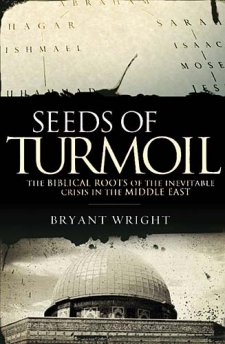
Recently I was privileged to review a book from Thomas Nelson called Seeds of Turmoil:  The biblical roots of the inevitable crisis in the Middle East.  The author is Bryant Wright, founding pastor of Johnson Ferry Baptist Church in Atlanta, Georgia.

Bryant Wright’s Seeds of Turmoil is a very enjoyable read!  In a simple, concise way he takes you back to the days of Abraham.  He shows you the sin of one man and the worldwide consequences brought forth from his sin.  Wright gives a peek into the life of Sarah, Hagar, Isaac, Ishmael, Esau and Jacob in a way that will make you reach for your Bible.  Combining biblical facts with current events, this book answers questioned that explained the hostility between the State of Israel and her neighboring Arab nations.  And it gives hope for all those who trust in the One and Only God of Abraham.  It is not only an interesting read but also very informative.  I will be adding this book to the list of studies to be used in the home discipleship of my oldest son and will recommend it to anyone who desires to learn more about God’s Chosen People.

Disclaimer:  I received Seeds of Turmoil from Thomas Nelson Publishers in exchange for an honest review.   I do not receive any other form of compensation for the reviews posted on this blog.

Troubled? Discouraged? Needing Confidence?

The signs of the times are ever before us. The news is depressing at best and down-right scary at worse. Many are left without hope. They have nowhere to turn, no answers, and merely an unwelcoming future. I can see why many are disheartened.

But the truth is that there is hope. There is hope when the financial market collapses. There is hope when the environment rages. There is hope when the political leaders fail. There is hope when your entire world crumbles. In a world full of despair it is refreshing to read a book that shines a light on that hope. That is just the type of book that Dr. David Jeremiah wrote in Living with Confidence in a Chaotic World.

In a striking contrast to his book, What in the World is Going on?, Dr. Jeremiah delivers a message of hope that is imperative for the troubled soul. In it he lays before us a plan of living the Christian life in this uneasy world. With the foundation of the Holy Scriptures, he inspires his readers to look beyond the immediate – that which is filled with concern, chaos, confusion, and commotion – and encourages us to lift our eyes to the eternal. Persuading the reader to stay calm, compassionate, constructive, challenged, connected, centered, consistent, committed, and convinced, Living with Confidence in a Chaotic World imparts a spirit of peace and confidence to the weary mind.

Do not be troubled; despite the darkness that surrounds us, there is hope in Jesus Christ. The light shines most brilliantly after the fiercest storm. And Living with Confidence in a Chaotic World paints that picture in a very straightforward way. It is a book that I will be recommending to friends this year.

Disclosure:  Thomas Nelson Publishers has provided me with a complimentary copy of this book in exchange for a honest review.  I am not required to write a positive review.  The opinions I have expressed are my own.

Why am I sick?

Even as a small child, sitting beside my father and mother in church, I noticed a pattern in prayer request.  It seems as though times have not changed much.  Almost every time when a prayer is mentioned it is for someone who is sick.  On occasions a dear saint might ask for the salvation of a lost family member or someone might ask for prayer for their family or for our country.  But I have noticed that most prayer request are for the sick, dying, and grieving.  When someone would give a testimony of praise it, as well, usually involved a healing from a sickness.  What is it about sickness that consumes so much of our prayer life?  As believers, why are physical concerns our only concerns?  Why are we not praying for our lost family members, friends, neighbors, and church members?  Why are we not praying for our missionaries as they battle in this spiritual war waged against them?  Why are we not praying for those who are destroying their own lives by living in sin?  Why are we not praying for our church families who are falling apart at the seams?  Why are we not praying for the immature, babes in Christ to grow in grace and knowledge?  Why are we not praying for the faithful mature believers to remain strong and true?  Why are we not praying for a spiritual hedge of protection upon our church?  Why are we not praying for God to raise up godly men who are willing to do the hard things necessary in our churches and nation?

 Perhaps it is the personal aspect.  Unfortunately, even children of God tend to be self-centered in our prayer life.  These types of prayers are hard to pray.  It takes a spiritually mature child of God to deny self and pray earnestly for others.  It takes hours and hours upon our knees to pray as we should.  It takes a rejection of this physical world to place our thoughts and affections upon spiritual things. It is easy to ask prayer for Brother So-and-so when he is sick, but it is a lot harder to pray for Brother So-and-so who lives in bitterness, strife, and constant sin.  It is a lot easier to pray for Sister So-and-so who is having surgery than to pray for Sister So-and-so who struggles with gossip. And it is a lot easier to ask prayer for ourselves when we are physically afflicted than to ask prayer for ourselves when we struggle and our faith is weak.  You see, it is easy to pray for the physical things but these are not the most important things.  It is only the spiritual things that will matter in eternity.  It is not our sickness that will matter as much as how we deal with our sickness.  When we become sick do we allow God to work in our lives, molding and shaping us into Christ’ image?  Do we see the hand of God working to draw us closer to Him during these times?  Do we see His perfect will being wrought in our lives and the lives of others?  It is these spiritual things in which we should pray.

 However, since sickness does acquire so much attention in our lives, it is important to recognize the different types.  Whether it is our sickness or others that we are praying for, God is sovereign in it all.  I believe that a child of God who diligently seeks the Lord and His face can petition God to reveal the purpose for the sickness.  In Scripture, I have found at least four reasons.

 The first and most apparent is the sickness unto death.  “And as it is appointed unto men once to die…”Hebrews 9:27a.  “For the wages of sin is death…” Romans 6:23a.  We are all under the curse of death and there comes a point in our lives, as a result of sin, that our physical bodies will die and return to the earth.  “And unto Adam he said, Because thou hast hearkened unto the voice of thy wife, and hast eaten of the tree, of which I commanded thee, saying, Thou shalt not eat of it: cursed is the ground for thy sake; in sorrow shalt thou eat of it all the days of thy life; Thorns also and thistles shall it bring forth to thee; and thou shalt eat the herb of the field; In the sweat of thy face shalt thou eat bread, till thou return unto the ground; for out of it wast thou taken: for dust thou art, and unto dust shalt thou return” Genesis 3:17-19.  Therefore, from the moment of birth we begin to physically die. The statistic is accurate.  Ten out of ten people die.  It is a part of life.  We should seek wisdom from God to know when we should stop praying for healing and begin praying for grace.  “Precious in the sight of the LORD is the death of his saints.” Psalm 116:15.

 There is also a sickness due to testing.  Job is an example of this.  “And the LORD said unto Satan, Behold, he is in thine hand; but save his life. So went Satan forth from the presence of the LORD, and smote Job with sore boils from the sole of his foot unto his crown” (Job 2:6-7).  There are times that God will send a sickness for no other purpose than to test our faith.  A mature believer can learn to be thankful for these times of testing.  For it is in trials that our faith grows.   “Knowing this, that the trying of your faith worketh patience. But let patience have her perfect work, that ye may be perfect and entire, wanting nothing” James 1:3-4.    

There is also a sickness for no other purpose than God’s glory.  Do you remember the story of Jesus healing the blind man?  Jesus and his disciples passed by a man who was blind from his birth.  The disciples asked, “Master, who did sin, this man, or his parents, that he was born blind?” John 9:2.  Jesus responded that neither the man sinned or his parents but “that the works of God should be made manifest in him.”  Do you remember the story of Mary and Martha sending messengers to Jesus about Lazarus’ sickness?  “When Jesus heard that, he said, This sickness is not unto death, but for the glory of God, that the Son of God might be glorified thereby” John 11:4.  I have heard story after story about a person who had cancer or some other fatal illness.  But then God in His mercy answered prayers and healed this person.  It was the sickness that revealed God’s glory to the world.

 The fourth cause of sickness is due to unconfessed sin in the believer’s life.  The Corinthian church was taking the Lord Supper unworthily and bringing about condemnation. “For this cause many are weak and sickly among you, and many sleep” 1Corinthians 11:30.  Many times God will chasten His children with an illness to bring them to repentance.  “As many as I love, I rebuke and chasten: be zealous therefore, and repent” Revelations 3:19.  God loves His children too much to let them remain in sin.  What would we think of a father who knowingly allowed his small child to play in the street?  We would think of him as unfit at best or even uncaring and cruel.   Why then, do we think that our Heavenly Father allows His children to play around with sin in the streets of destruction?  He is holy, perfect, and just, therefore, He corrects His children.  There are many backsliding believers who are under the judgment of God.  They need to humbly confess, turn away from their sin, and turn back to God.  James 5:14-16 gives us the remedy for someone who is sick due to sin.  “Is any sick among you? let him call for the elders of the church; and let them pray over him, anointing him with oil in the name of the Lord: And the prayer of faith shall save the sick, and the Lord shall raise him up; and if he have committed sins, they shall be forgiven him. Confess your faults one to another, and pray one for another, that ye may be healed. The effectual fervent prayer of a righteous man availeth much.”

 Why am I sick?  I do not believe it is wrong to ask this question.  Seek the Lord for the answer.  Whether it is a sickness unto death or as a test of faith let it be as a witness for God’s glory.  If it is a sickness due to sin, confess your sins and “despise not thou the chastening of the Lord, nor faint when thou art rebuked of him: For whom the Lord loveth he chasteneth, and scourgeth every son whom he receiveth. If ye endure chastening, God dealeth with you as with sons; for what son is he whom the father chasteneth not?” Hebrews 12:5-7.


There is a love that God hates!

broken heart

Yesterday in the news I read a story about an eleven year old girl who was abducted on her way home from school and kept hidden in her abductors backyard for nearly two decades.   She was raped and gave birth to two children by this evil man.  While thinking about the story my heart broke.  I have a little girl who is nearly 11 years old.  Just the thought brings horror.  And people wonder why I do not let my children out of my sight.  We live in an evil world.  There are many people who are evil and they love evil works of darkness.   “Why boastest thou thyself in mischief, O mighty man? the goodness of God endureth continually. Thy tongue deviseth mischiefs; like a sharp razor, working deceitfully. Thou lovest evil more than good; and lying rather than to speak righteousness. Selah. Thou lovest all devouring words, O thou deceitful tongue. God shall likewise destroy thee for ever, he shall take thee away, and pluck thee out of thy dwelling place, and root thee out of the land of the living. Selah.”  Psalm 52:1-5         

Too many times I have heard sayings like this…  “A loving God would never send anyone to hell.”  Or “God is love, He cannot hate.”  Can I tell you that because God is love He must hate!  I love the Word of God therefore I hate false teaching.  I love freedom therefore I hate slavery.  I love the God ordained institution of marriage therefore I hate divorce, adultery, and homosexuality.  I love children therefore I hate abortion.  I love the truth therefore I hate lying.  I love everything that is good and holy therefore I hate everything that is evil.  “I have hated the congregation of evil doers; and will not sit with the wicked.” Psalm 26:5  “Ye that love the LORD, hate evil:” Psalm 97:10a                

There is a love that God hates.  Ask yourself, does God hate it when we have love for the things of this world?  “Love not the world, neither the things that are in the world. If any man love the world, the love of the Father is not in him. For all that is in the world, the lust of the flesh, and the lust of the eyes, and the pride of life, is not of the Father, but is of the world.”  1John 2:15-16   “Ye adulterers and adulteresses, know ye not that the friendship of the world is enmity with God? whosoever therefore will be a friend of the world is the enemy of God.”  James 4:4

 So I must ask, “Are there things in my life that I love and yet God absolutely hates?”   “Do I love the world?”  “Do I love the things of this world?”  “Do I watch things on TV that grieves the Lord?  Do I listen to or read things that God hates?”   “Do I think and mediate upon things that God hates?”  “Is my affection set on things of the earth or on things above?”  May I never love the things that God hates.

The Slave

chains

The story of Onesimus speaks to my heart

From Philemon his owner, this man did part

And ran away and joined another

Paul – apostle, prisoner, and brother.

The Word was taught for man to do right

It’s wrong for a slave to run and take flight.

Go back, serve your master it would be better

But take comfort my friend, I’ll send a letter.

On your behalf any debt I will repay;

I’ll take it upon myself, it’s the only way.

With Paul as his intercessor, willing to repent,

Back to Philemon he was sent.

Not only a slave but now a brother

For Onesimus gladly serves another.

Another story of a slave let me tell,

This one was bound and headed for hell.

My master was Satan and I served only sin

I would serve him today had grace not been.

The wages due was nothing but death

No hope within, there was nothing left.

Until the day a new Master sought me

Breaking chains of bondage setting me free.

The debt I owed – my Lord paid it all,

He lifted me up out of the fall.

Now no longer just a poor slave

From my Master new life He gave.

As joint-heirs He is also my brother

For now I gladly serve another.